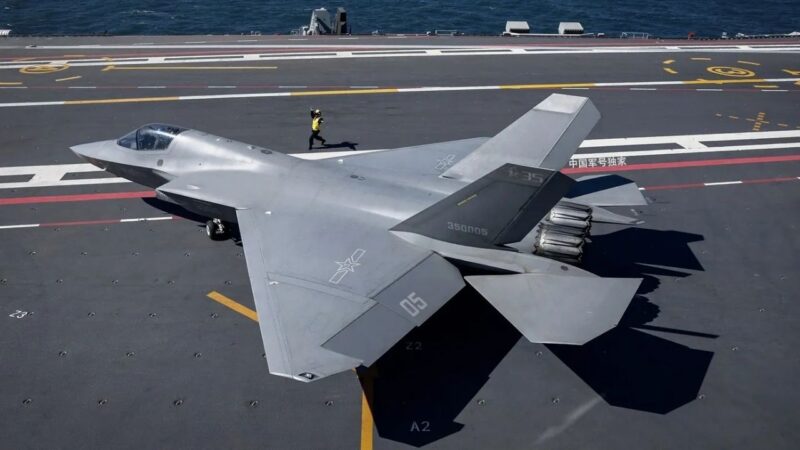
The Pakistan Air Force (PAF) has unveiled plans to acquire stealth multirole combat aircraft J-35 while further modernising its fleet through additional acquisitions of Chengdu J-10C aircraft and major upgrades to jointly produced JF-17 fighter jets.
According to Chinese media reports, PAF Deputy Chief of Air Staff Air Vice-Marshal Tariq Ghazi has confirmed that an “initial collaborative agreement” has been signed for the J-35 acquisition.
While he did not reveal the scope of the deal, the PAF official did confirm plans for additional Chengdu J-10C fighters and upgrades to the JF-17 jets co-produced with China, a year after Pakistan proved its battle readiness, particularly air superiority, in the clashes against India.
Ghazi stated that “foundations have been laid for the acquisition of advanced capabilities”, which he said included long-range precision weapons, next-generation platforms, additional J-10Cs and “much upgraded” JF-17s.
Speculation has been building that Pakistan could receive an initial batch of J-35s before the end of this year, after Chinese state broadcaster CCTV aired footage last week showing the first fully operational export version of the aircraft.
With Pakistan currently the only known overseas customer for the jet, Beijing had earlier offered Islamabad 40 J-35 warplanes, KJ-500 early-warning aircraft and HQ-19 surface-to-air missile systems in June last year, though neither side had officially confirmed the deal until this Thursday.
Analysts say that the induction of Chinese fifth-generation fighters would shift the air power equation with India, which operates a larger fleet of 4.5-generation jets sourced from France and Russia but has yet to field stealth warplanes of its own.
Amalendu Misra, professor of international politics at Lancaster University, stated that the technology transfer would “massively strengthen” the China-Pakistan all-weather friendship but would be of “deep concern” to India.
“It is likely to lead to a much more intense arms race in the South Asian region,” Misra remarked.
Vijainder Thakur, a retired Indian Air Force (IAF) squadron leader and fighter pilot, noted that the acquisition would “certainly make the PAF a more dangerous adversary than it already is”.
He added that even two to three J-35 squadrons “could significantly dent India’s numerical advantage in fighters” as it would force the IAF to commit a larger portion of its Su-30MKI fleet to air defence duties, explaining that stealth fighters are designed to evade ground-based radars, pushing opposing air forces to rely on airborne radar systems instead.
Muhammad Faisal, a South Asia security researcher at the University of Technology Sydney, noted that Beijing’s decision to supply J-35s would have come from the highest levels. He pointed out that China had previously finalised the J-10C deal only after India took delivery of French Rafale jets in 2021.