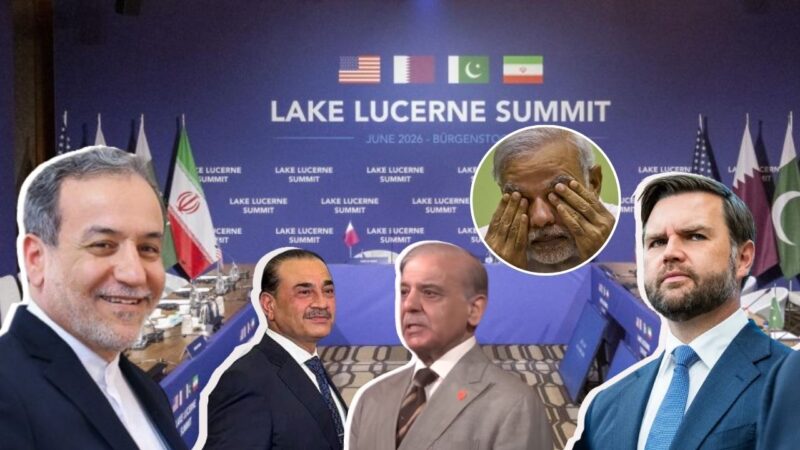
Esteemed Indian defence analyst Praveen Sawhney has asserted that Pakistani policymakers possess a superior, more “experienced” understanding of handling Washington than their Indian counterparts.
Speaking on regional security dynamics, Sawhney agreed with a premise raised by the host, who quoted Henry Kissinger’s famous maxim that “to be an enemy of America can be dangerous, but to be a friend is fatal.” Agreeing with the observation, Sawhney remarked that “that is what India did because we became partners,” contrastingly arguing that Islamabad uniquely understands exactly when to build bridges and “when to detach” from the United States to protect its own national interests.
Sawhney explained that Islamabad’s unique diplomatic capability is highly valued because of its broad acceptability to major global powers, specifically China and Russia. Further, the institutional expertise possessed by Pakistan is an element that makes it the most viable mediator for the United States and Iran.
Reflecting on the rigidity of current alignments, Sawhney stated, “The biggest mistake that India has made is to think that America will treat India as an equal partner, which is not going to happen.”
The underlying reason for this enduring position is that Pakistan’s military leadership possesses extensive historical and structural experience in navigating complex foreign policy, maintaining a consistent strategy that allows them to engage effectively with Washington without compromising regional ties.
The analyst strongly critiqued New Delhi’s current foreign policy alignment, specifically its singular focus on its partnership with the United States, describing it as an unviable long-term policy because Washington routinely treats bilateral partnerships unequally. This misstep comes at a critical time when global attention has decisively shifted away from the Indo-Pacific region and back to Eurasia, fundamentally altering the regional balance in Pakistan’s favour.
Within this shifting paradigm, Pakistan holds a distinct advantage due to a combination of three foundational factors: its unique geographic location, its status as a Muslim nation, and its possession of nuclear weapons.
He further noted that European Union foreign policy officials have increasingly recognised Pakistan as a major regional power. According to Sawhney, this acknowledgement stems directly from Islamabad’s demonstrated strategic leverage and resilience, mirroring historical instances where the United States was compelled to engage with Pakistan due to its indispensable regional influence.
In conclusion, Sawhney argued that Pakistan’s institutional continuity and multifaceted strategic assets provide it with durable leverage in a shifting global order. Consequently, despite complex economic dependencies, its unique position ensures it remains an essential geopolitical player that global powers simply cannot bypass.