
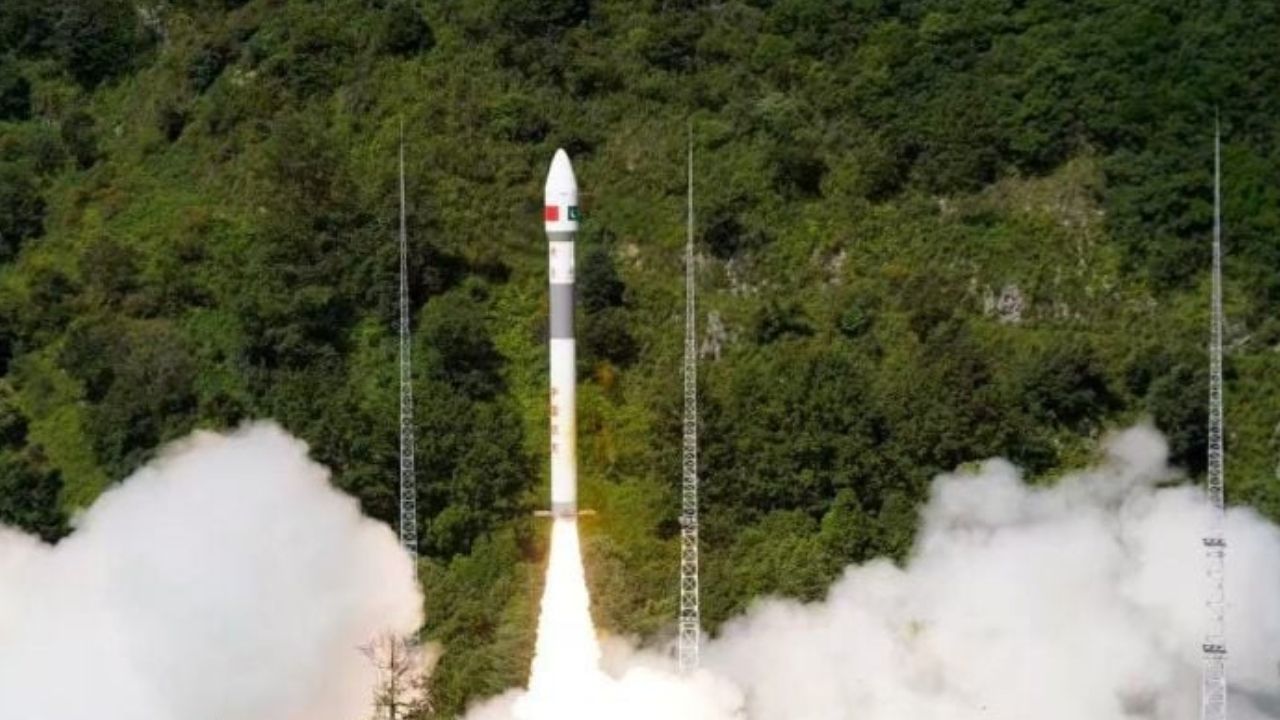


Pakistan has successfully launched a state-of-the-art remote sensing satellite into orbit on Thursday, marking a major milestone in the country's space program.
The launch took place at 7:38 am Pakistan Standard Time from China’s Xichang Satellite Launch Centre, with senior officials from the Space and Upper Atmosphere Research Commission (SUPARCO) present at the site.
The event was broadcast live from SUPARCO’s headquarters in Karachi, highlighting the national importance of the achievement.
Equipped with advanced electro-optical and hyperspectral sensors, the satellite is designed to provide real-time data for a wide range of applications including disaster prediction, agricultural assessment, environmental monitoring, and urban development.
“This is a landmark achievement in Pakistan’s space journey,” said the Director General of SPARC, calling the launch a “major breakthrough” that will support national development and improve disaster resilience. “It will not only help us in effective disaster management but also in food security, infrastructure planning and climate response.”
Officials say the satellite will significantly enhance the country’s ability to issue early warnings for natural disasters such as floods, earthquakes, and landslides, which have long impacted communities and infrastructure. The satellite’s monitoring capabilities are also expected to play a critical role in addressing food security challenges by providing accurate crop data amid shifting climate conditions.
Additionally, the satellite will be used to track infrastructure development, particularly projects related to the China-Pakistan Economic Corridor (CPEC), offering a more detailed and real-time overview of ongoing progress and compliance.
This mission builds on Pakistan’s previous advancements in space technology. In 2018, the country launched its first remote sensing satellite, PRSS-1, alongside the Pakistan Technology Evaluation Satellite (PakTES-1A). These missions laid the foundation for more sophisticated satellite launches, including the recent EO-1 electro-optical satellite, which expanded Pakistan’s presence in low Earth orbit.
The latest launch is seen as a significant step forward in utilizing space technology for national development and regional collaboration.
'%3e%3crect%20y='0.445312'%20width='48'%20height='48'%20rx='24'%20fill='white'%20fill-opacity='0.5'/%3e%3crect%20x='0.5'%20y='0.945312'%20width='47'%20height='47'%20rx='23.5'%20stroke='%23808080'/%3e%3cpath%20d='M34.625%2024.4453L14%2024.4453'%20stroke='%23808080'%20stroke-width='0.920053'/%3e%3cpath%20d='M23.375%2034.4453L13.375%2024.4453L23.375%2014.4453'%20stroke='%23808080'%20stroke-width='0.920053'/%3e%3c/g%3e%3cdefs%3e%3cfilter%20id='filter0_b_489_44344'%20x='-12'%20y='-11.5547'%20width='72'%20height='72'%20filterUnits='userSpaceOnUse'%20color-interpolation-filters='sRGB'%3e%3cfeFlood%20flood-opacity='0'%20result='BackgroundImageFix'/%3e%3cfeGaussianBlur%20in='BackgroundImageFix'%20stdDeviation='6'/%3e%3cfeComposite%20in2='SourceAlpha'%20operator='in'%20result='effect1_backgroundBlur_489_44344'/%3e%3cfeBlend%20mode='normal'%20in='SourceGraphic'%20in2='effect1_backgroundBlur_489_44344'%20result='shape'/%3e%3c/filter%3e%3c/defs%3e%3c/svg%3e)
'%3e%3crect%20y='0.445312'%20width='48'%20height='48'%20rx='24'%20fill='white'%20fill-opacity='0.5'/%3e%3crect%20x='0.5'%20y='0.945312'%20width='47'%20height='47'%20rx='23.5'%20stroke='%23808080'/%3e%3cpath%20d='M13.375%2024.4453L34%2024.4453'%20stroke='%23808080'%20stroke-width='0.920053'/%3e%3cpath%20d='M24.625%2014.4453L34.625%2024.4453L24.625%2034.4453'%20stroke='%23808080'%20stroke-width='0.920053'/%3e%3c/g%3e%3cdefs%3e%3cfilter%20id='filter0_b_489_44344'%20x='-12'%20y='-11.5547'%20width='72'%20height='72'%20filterUnits='userSpaceOnUse'%20color-interpolation-filters='sRGB'%3e%3cfeFlood%20flood-opacity='0'%20result='BackgroundImageFix'/%3e%3cfeGaussianBlur%20in='BackgroundImageFix'%20stdDeviation='6'/%3e%3cfeComposite%20in2='SourceAlpha'%20operator='in'%20result='effect1_backgroundBlur_489_44344'/%3e%3cfeBlend%20mode='normal'%20in='SourceGraphic'%20in2='effect1_backgroundBlur_489_44344'%20result='shape'/%3e%3c/filter%3e%3c/defs%3e%3c/svg%3e)