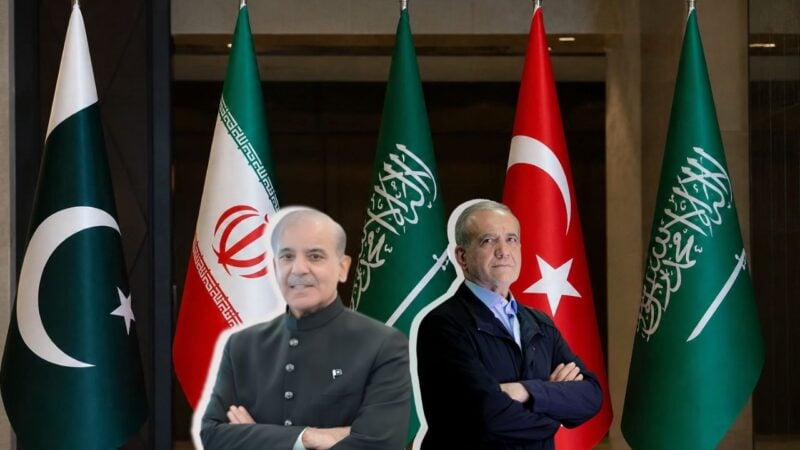
Speculation regarding the formation of a prospective Islamic regional security alliance, with Pakistan positioned as its potential leader, has gained significant traction over the internet.
But is it really happening?
The discourse stems directly from a statement made by Iranian President Masoud Pezeshkian during his one-day official visit to Islamabad on Wednesday.
Amidst discussions on regional stability, President Pezeshkian explicitly called for a “united front” of Muslim nations, stating, “We stretch our hands of friendship to establish a common understanding and build a new security structure for the countries in the region.”
While there has been no official confirmation regarding the creation of a formal military or security bloc, observers and geopolitical analysts suggest that Pakistan is the most viable candidate to spearhead such an initiative as the only nuclear-armed state within the Muslim world.
Furthermore, the argument is frequently bolstered by referencing the Strategic Mutual Defence Agreement (SDMA) signed between Pakistan and the Kingdom of Saudi Arabia in September last year, which observers view as a foundational building block for broader regional security cooperation.
Earlier, President Pezeshkian’s visit was marked by high-level engagements with Prime Minister (PM) Shehbaz Sharif, President Asif Ali Zardari and Field Marshal Asim Munir, building on the momentum of the Islamabad Memorandum of Understanding (MoU) signed on June 18.
During the joint press conference, PM Shehbaz highlighted the depth of the bilateral relationship, remarking, “It was like a family reunion, and brothers were talking to each other with the fullest clarity and total commitment that we will do everything to strengthen our brotherly relations like never before.”
The talks focused heavily on the necessity of “straightforward and honest” discussions to ensure long-term stability in West Asia and the Persian Gulf.
A significant highlight of the trip included PM Shehbaz conferring an honorary fellowship of the College of Physicians and Surgeons of Pakistan specialising in cardiac surgery upon the Iranian president.
The visit also served as an essential diplomatic venue for clearing misconceptions. Both PM Shehbaz and President Pezeshkian categorically clarified that Iran’s ballistic missile programme was never part of the recent peace accords, with the Iranian leader emphasising that Tehran would “never compromise” on its defensive capabilities.
The visit concluded with a mutual pledge to prioritise economic and trade integration, with the premier announcing a reciprocal trip to Tehran next week to pay respects to the late Supreme Leader Ayatollah Ali Khamenei, further cementing the bilateral commitment to regional progress.