
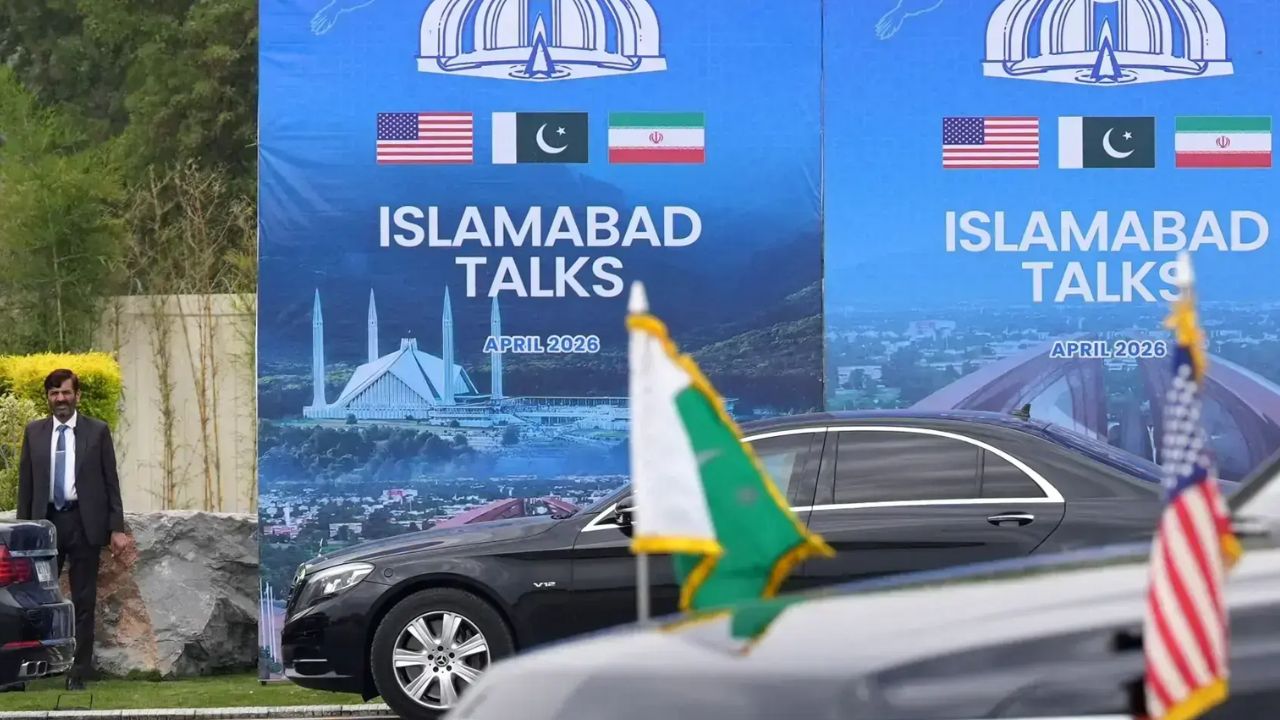


Pakistan's media faced a barrage of criticism over the weekend for how it handled coverage of the crucial Iran-US negotiations in Islamabad, with both international and local journalists calling out unprofessional reporting and a lack of substance.
The high-stakes two-day talks that kicked off on Saturday saw Pakistani journalists resort to cryptic social media posts and pure speculation.
Posts flooded in on X saying things like "Guess who is in the room," "Key development... keep tuned," and "Talks start" with no concrete details behind them.
One observer noted that while foreign journalists treated the event with due gravity, some local outlets turned it into "a TikTok show," adding there was "Absolute lack of professionalism and shameful behavior”.
Ather Kazmi explained what actually went down. Pakistani media wasn't even close to where negotiations were happening. Foreign journalists had access, but Pakistani journalists weren't granted entry to the hotel.
"It's not the government's responsibility to give news to journalists," Kazmi pointed out, "but if there were American journalists, the government should at least have given Pakistani journalists a chance in their own country”.
"In Pakistan, the way experts, reporters, and pundits built up the hype, people started expecting breaking news every moment," Kazmi said. He acknowledged the arrangements were solid but stressed that when there's no news, journalists shouldn't resort to "childish tweets”. He urged the media to take the criticism constructively instead of getting defensive.
Veteran television host Nasim Zehra commended the Information and Broadcasting Ministry for running the media hall efficiently over nearly 24 hours. But she underlined the irony: "You kept media from the world over engaged in a space with ZERO NEWS".
Kamran Yousaf, a Pakistani journalist shifted the focus to the root cause. "It's not the government's job to help journalists," he stated. "For local journalists not being able to report as desired, it has to do with their own capacity or lack of it”.
Yousaf pointed out that Pakistan has no concept of specialised reporting. "Today, you are giving weather updates, tomorrow, you are assigned to cover the FO briefing and the next morning the Parliament session," he explained.
"Why do our local journalists struggle to report Islamabad talks when little or no information is available? Because they were looking at the event only through Pakistan's lens," Yousaf noted.
He mentioned meeting foreign journalists during the talks, most of whom were Iran or Middle East experts. "Those media outlets don't just deploy their primetime anchors or random people to cover every event," he added, making a point about how international outlets send specialists.
Caitlin Doornbos, a foreign policy reporter, offered perspective on why international coverage was different. "Foreign media present were by and large specialised in foreign policy coverage," she noted. She also cautioned that while relying on government information hinders reporting, "it can also be dangerous for society to only rely on what govt says”.
Absa Komal, Pakistani journalist and anchor, acknowledged Pakistani media's lack of organization but brought up a structural problem: internationally, prime-time anchors are sent to cover major events, but they have reporting teams and subject experts backing them.
"Pakistani media is unorganized, there's no doubt about that," Komal stated, adding that the real issue is channels don't employ paid panels of expert reporters. "Viewers have now given up on local media," she noted, hoping the criticism would push for change.
Ajmal Jami singled out standouts among those covering the talks, naming Jennifer Jacobs, Kamran Yousaf, Sophia Saifi, Caitlin Doornbos, and Azaz Syed, along with Phil Stewart. "The rest, frankly, added more noise than insight," he stated.
One reaction pointed out that local media was completely sidelined. "No insights, just selfies and 'out and about in Islamabad' kind of photos, followed by brief appearances at an empty convention centre focusing on food and logistics," the person noted.
They added that the government could have used the opportunity to boost Pakistani journalists' presence on international platforms instead.
Another questioned the complaints altogether. "A center was established for media facilitation during the negotiations in the convention center. What's there to cry about so much over this. Field journalists know that sitting outside the negotiations and waiting the whole day is called pole duty," she stated.
One comment offered sharp criticism: "For the first time Pakistani journalists are getting criticism not just at home but from foreign journalists as well and they don't know how to handle it because they can't just call them cultists or youthias and move on. Introspect and do better instead of stupid justifications”.
Umar Cheema, another veteran journalist from a private media outlet, reframed the entire debate. "Want neutral journalists? Name ONE you actually watch/read regularly. How many neutral journalists get high ratings? People hate neutrality. So why demand it?" he questioned.
He pushed further: "Tell them verified facts that contradict their bias, and they label you with every bad name”. He indicated the problem goes beyond media performance to what audiences actually want.
An international observer drew a comparison: "Nic Robertson is not covering showbiz and Christiane Amanpour is not doing US domestic politics. Real journalists specialize. Pakistani YouTube journos somehow manage geopolitics, economy, defense, religion and probably have a space program breakdown coming next”.
'%3e%3crect%20y='0.445312'%20width='48'%20height='48'%20rx='24'%20fill='white'%20fill-opacity='0.5'/%3e%3crect%20x='0.5'%20y='0.945312'%20width='47'%20height='47'%20rx='23.5'%20stroke='%23808080'/%3e%3cpath%20d='M34.625%2024.4453L14%2024.4453'%20stroke='%23808080'%20stroke-width='0.920053'/%3e%3cpath%20d='M23.375%2034.4453L13.375%2024.4453L23.375%2014.4453'%20stroke='%23808080'%20stroke-width='0.920053'/%3e%3c/g%3e%3cdefs%3e%3cfilter%20id='filter0_b_489_44344'%20x='-12'%20y='-11.5547'%20width='72'%20height='72'%20filterUnits='userSpaceOnUse'%20color-interpolation-filters='sRGB'%3e%3cfeFlood%20flood-opacity='0'%20result='BackgroundImageFix'/%3e%3cfeGaussianBlur%20in='BackgroundImageFix'%20stdDeviation='6'/%3e%3cfeComposite%20in2='SourceAlpha'%20operator='in'%20result='effect1_backgroundBlur_489_44344'/%3e%3cfeBlend%20mode='normal'%20in='SourceGraphic'%20in2='effect1_backgroundBlur_489_44344'%20result='shape'/%3e%3c/filter%3e%3c/defs%3e%3c/svg%3e)
'%3e%3crect%20y='0.445312'%20width='48'%20height='48'%20rx='24'%20fill='white'%20fill-opacity='0.5'/%3e%3crect%20x='0.5'%20y='0.945312'%20width='47'%20height='47'%20rx='23.5'%20stroke='%23808080'/%3e%3cpath%20d='M13.375%2024.4453L34%2024.4453'%20stroke='%23808080'%20stroke-width='0.920053'/%3e%3cpath%20d='M24.625%2014.4453L34.625%2024.4453L24.625%2034.4453'%20stroke='%23808080'%20stroke-width='0.920053'/%3e%3c/g%3e%3cdefs%3e%3cfilter%20id='filter0_b_489_44344'%20x='-12'%20y='-11.5547'%20width='72'%20height='72'%20filterUnits='userSpaceOnUse'%20color-interpolation-filters='sRGB'%3e%3cfeFlood%20flood-opacity='0'%20result='BackgroundImageFix'/%3e%3cfeGaussianBlur%20in='BackgroundImageFix'%20stdDeviation='6'/%3e%3cfeComposite%20in2='SourceAlpha'%20operator='in'%20result='effect1_backgroundBlur_489_44344'/%3e%3cfeBlend%20mode='normal'%20in='SourceGraphic'%20in2='effect1_backgroundBlur_489_44344'%20result='shape'/%3e%3c/filter%3e%3c/defs%3e%3c/svg%3e)