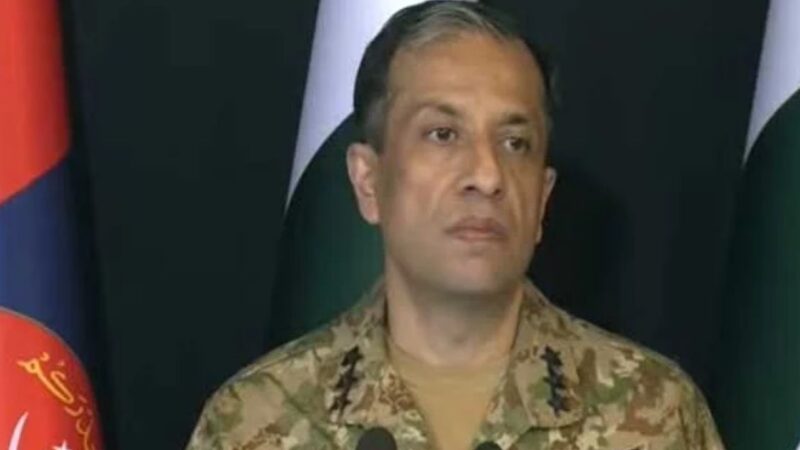
Pakistan’s military on Tuesday rejected an Indian documentary on so-called “Operation Sindoor”, accusing New Delhi of attempting to present a failed military operation as a success through what it described as a “Bollywood-style” production.
In a statement, the Inter-Services Public Relations (ISPR) said that India was still unwilling to accept the outcome of Marka-i-Haq, the name Pakistan uses for the military confrontation between the two countries in 2025.
“More than a year after Marka-i-Haq, India refuses to face the harsh reality. Instead of conceding defeat in a failed venture, India has decided to colour history in her preferred hues,” the military’s media wing stated.
The conflict between Pakistan and India began after the April 22, 2025, attack in Pahalgam and ended on May 10 following a ceasefire after the United States (US) intervened. Pakistan later named the military confrontation Marka-i-Haq.
ISPR has said that the documentary, which features members of India’s political and military leadership, presented a “highly dramatised, coloured and factually inaccurate account” of Operation Sindoor, the term used by India for the strikes it carried out against Pakistan on May 7, 2025.
“To achieve this mutilation of history, Indian content creators have produced a highly dramatised, coloured and factually inaccurate account of so-called Operation Sindoor, packaged as a documentary featuring senior political and military leadership of India,” the statement read.
The military’s media wing argued that the production relied on edited interviews, emotional narration and cinematic reconstructions to reshape the sequence of events.
“For its lack of nuance and seriousness, the documentary can be characterised as a tragedy and a comedy at the same time. Selectively edited interviews, emotional narration and cinematic Bollywood style reconstruction have been used to alter established facts and rewrite the operational outcome,” ISPR said.
The statement also questioned the documentary’s attempt to connect an April 16, 2025, address by the army chief to the April 22 Pahalgam attack.
According to ISPR, India later announced that the three alleged attackers involved in Pahalgam had been identified and killed on July 28, 2025, raising questions about the documentary’s claim that Operation Sindoor had been launched to punish those responsible for the attack.
“If the alleged perpetrators were eliminated on July 28, India must explain, who it claims to have punished on May 7, 2025,” the statement said.
Rejecting the documentary’s claim of “100 percent mission success”, ISPR maintained that Pakistan had repelled Indian military action during Marka-i-Haq and shot down eight military aircraft.
It further stated that Pakistan later launched Operation Bunyan al-Marsoos targeting 26 military sites using Fatah precision-guided rockets, missiles, Pakistan Air Force munitions, long-range loitering munitions and artillery.
ISPR also pointed to what it described as contradictions within the documentary itself, noting that Indian military officials acknowledged Pakistani missile, drone and air operations, as well as continued military activity along the Line of Control (LOC).
The statement further argued that the documentary’s own description of how hostilities ended contradicted its claim of a unilateral Indian victory.
“Its own narration confirms that hostilities ended through communication between the two director general military operations and an agreed cessation of military action. This alone contradicts the attempt to portray Operation Sindoor as a unilateral Indian military triumph,” ISPR stated.
The military’s media wing also questioned the documentary’s portrayal of escalation, saying it simultaneously claimed India had achieved escalation dominance while also arguing that New Delhi intentionally kept the conflict limited and offered Pakistan an “exit window”.
“These competing claims expose the production as a carefully constructed domestic narrative rather than an objective military account. India has not declassified the truth. It has cobbled together a propaganda video to project a military blunder as a successful endeavour,” the statement said.
“No amount of cinematic reconstruction can change the chronology, erase aircraft losses, conceal military casualties, alter the military engagements that actually took place or convert a battlefield defeat into a self-proclaimed victory,” it added.