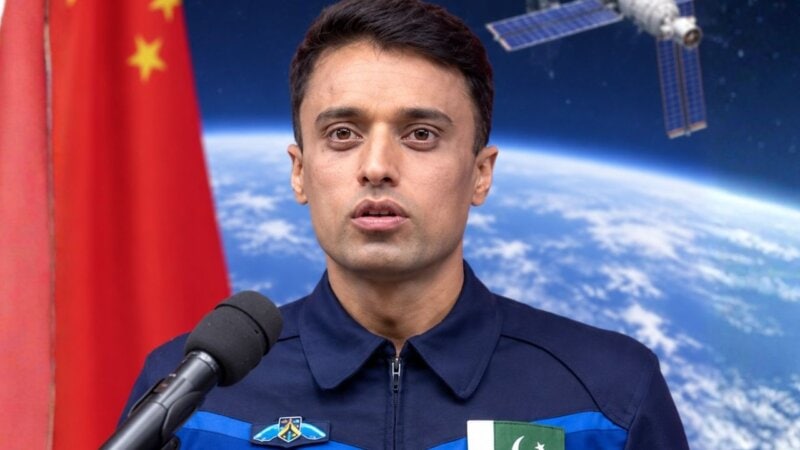
Pakistani astronaut Muhammad Zeeshan Ali has said that he picked up space flight skills and learned Chinese during his training in China, days before he becomes the first Pakistani to fly in an orbital space mission.
“First, I have acquired space flight skills,” Ali told reporters at a press briefing in Jiayuguan. “The management, staff and instructors at the Astronaut Centre of China have provided me with comprehensive training […] Day after day, I take another step upward.”
He said the language was part of that training. “I have learned the Chinese language and developed a friendship with my Chinese colleagues. Now, I can communicate with my Chinese crewmates in Chinese.”
Ali arrived at the Astronaut Centre of China a few months ago. He said what he gained there far exceeded his expectations, and he thanked the Chinese government for helping “us realise our dream of going into space.”
“We trained side by side, and our friendship embodies the friendship between China and Pakistan: higher than the mountains, deeper than the oceans, sweeter than honey and as vast as outer space,” he stated.
The China Manned Space Agency (CMSA) named him to the crew of Shenzhou-24 on Tuesday. The spacecraft will lift off at 8:18am Beijing time (5:18am Pakistan time) on Wednesday from the Jiuquan Satellite Launch Center in northwest China. Ali will also be the first foreign national to board China’s Tiangong space station.
“Pakistani astronaut Mohammad Zeeshan Ali is the first foreign national to visit Tiangong,” CMSA spokesperson Zhang Jingbo confirmed at a press conference.
Ali and fellow astronaut Khurram Daud began training in China after their selection in April. The pair trained under a cooperation agreement that Pakistan’s space agency Suparco and the CMSA signed in February 2025. The deal called for two Pakistanis to train in China, with one joining a mission to Tiangong.
Ali will serve as payload specialist. Chinese astronaut Tang Hongbo, 51, will command the mission, and Wu Yi will pilot it on his first voyage to space. Ali will spend about a week in orbit and run experiments with the Chinese crew, which plans around 90 experiments in total. The crew will also swap places with the Shenzhou-23 team, maintain the station and continue space science research.
The crew now aboard Tiangong includes Zhu Yangzhu, Lai Ka-ying and Zhang Zhiyuan. Lai is Hong Kong’s first astronaut and the only woman at the station. Ali will return to Earth with Lai and Zhang on the Shenzhou-23 spacecraft, which docked with the station in May. Zhu will stay on board to complete China’s first full-year stay in space.
Ali said that he carries Pakistan with him. “I am not flying for myself. I carry the name of Pakistan on my shoulder, the hopes of 250 million Pakistanis,” he said. He also had a message for the country’s children. “To every child who is watching while I am in orbit, just look up at the sky and remember that I am up there with your dreams.”
He called the flight a beginning. “This mission is not a finish line; it is a launch pad,” he observed. He hopes China-Pakistan space cooperation will grow “from one astronaut, one flight to multiple joint flights, to the Moon, Mars and beyond.”
Ali noted that 2026 marks the 75th anniversary of China-Pakistan space cooperation and of diplomatic relations between the two countries.
China has invested heavily in its space programme and aims to land astronauts on the Moon by 2030. The United States prohibited NASA from working with Chinese space agencies in 2011, which has kept China out of the International Space Station.
Beijing has since looked for partners elsewhere, including Pakistan.