
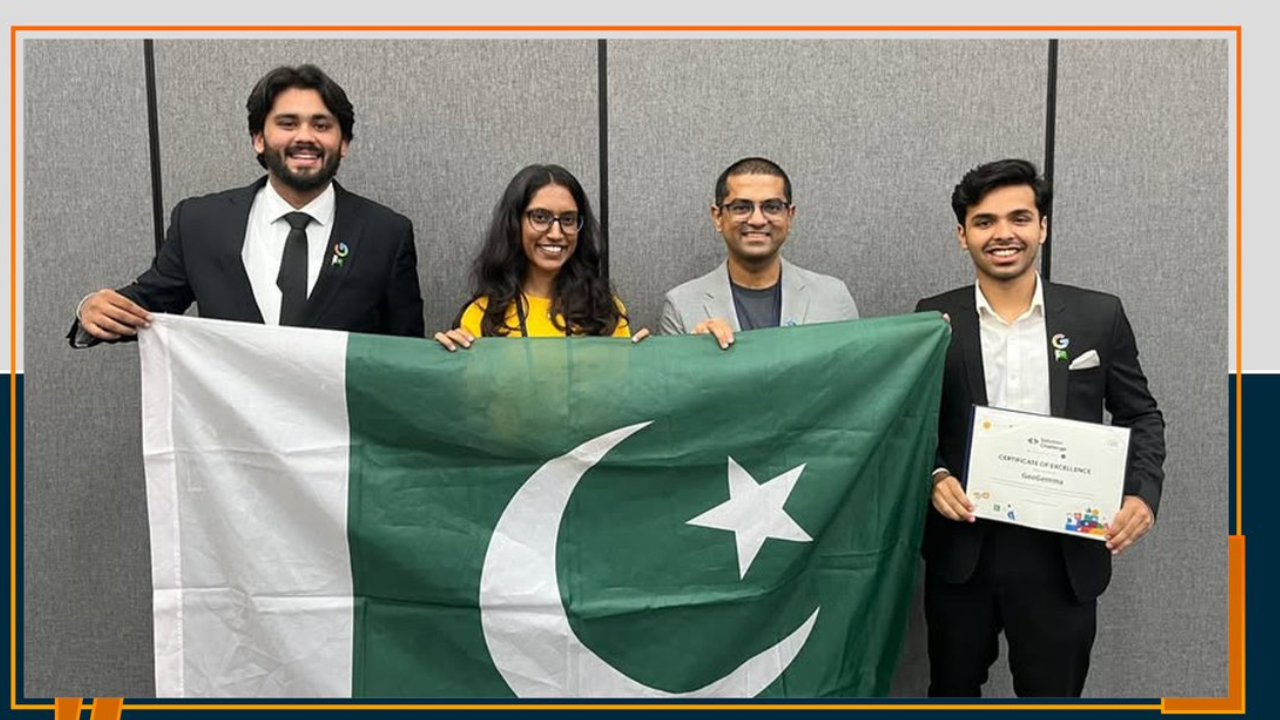


Students from Islamabad's Institute of Space Technology (IST) have been awarded the 'Best AI Use Case' at the 2025 Google APAC Solution Challenge held in Manila. Their creation, GeoGemma, was chosen from over 750 submissions from more than 200 universities in the Asia-Pacific region.
GeoGemma is an open-source application that streamlines the analysis of satellite data. It utilizes a Large Language Model (LLM) combined with Google Earth Engine, enabling users to examine geospatial data through natural language queries, thus removing the need for programming skills.
The concept was conceived by Ahmed Iqbal and Hanzila Bin Younus in 2024 as part of their final-year project in space sciences at IST. They applied for a research grant through the Gemma Academic Programme by Google DeepMind and successfully obtained $10,000 in funding. Their supervisor, Dr. Sajid Ghaffar, joined the initiative to create a team dedicated to developing a tool that makes Earth Engine accessible for non-programmers.
To enhance their project for the competition, the team recruited two additional IST students. Abdullah Asif focused on front-end development, while Khaleelullah took charge of AI engineering. Together, they constructed a model capable of retrieving and processing satellite data using straightforward input prompts, simplifying the process for users lacking technical expertise.
GeoGemma can extract spatial data such as thermal imaging or temperature measurements by superimposing maps with satellite information. The tool is applicable across various industries, including oil and gas, real estate, sustainability, and logistics.
In contrast to many AI tools that necessitate cloud computing or advanced systems, GeoGemma's model is less than 2GB and can operate on standard laptops. The team noted that this design decision was made to enhance accessibility and lessen reliance on servers.
Another group from Pakistan students from Fast University also reached the top 10 finalists at the competition. Their project involved creating a Gemini-powered document editor aimed at assisting neurodivergent users.
GeoGemma was highlighted as one of the top 10 innovations presented during the final round in Manila, where the team represented Pakistan. Their tool was acknowledged for its capacity to automate geospatial analysis and for offering an AI-driven solution that could have practical applications.
The team is currently seeking to collaborate with industries to create customized modules for various sectors.
'%3e%3crect%20y='0.445312'%20width='48'%20height='48'%20rx='24'%20fill='white'%20fill-opacity='0.5'/%3e%3crect%20x='0.5'%20y='0.945312'%20width='47'%20height='47'%20rx='23.5'%20stroke='%23808080'/%3e%3cpath%20d='M34.625%2024.4453L14%2024.4453'%20stroke='%23808080'%20stroke-width='0.920053'/%3e%3cpath%20d='M23.375%2034.4453L13.375%2024.4453L23.375%2014.4453'%20stroke='%23808080'%20stroke-width='0.920053'/%3e%3c/g%3e%3cdefs%3e%3cfilter%20id='filter0_b_489_44344'%20x='-12'%20y='-11.5547'%20width='72'%20height='72'%20filterUnits='userSpaceOnUse'%20color-interpolation-filters='sRGB'%3e%3cfeFlood%20flood-opacity='0'%20result='BackgroundImageFix'/%3e%3cfeGaussianBlur%20in='BackgroundImageFix'%20stdDeviation='6'/%3e%3cfeComposite%20in2='SourceAlpha'%20operator='in'%20result='effect1_backgroundBlur_489_44344'/%3e%3cfeBlend%20mode='normal'%20in='SourceGraphic'%20in2='effect1_backgroundBlur_489_44344'%20result='shape'/%3e%3c/filter%3e%3c/defs%3e%3c/svg%3e)
'%3e%3crect%20y='0.445312'%20width='48'%20height='48'%20rx='24'%20fill='white'%20fill-opacity='0.5'/%3e%3crect%20x='0.5'%20y='0.945312'%20width='47'%20height='47'%20rx='23.5'%20stroke='%23808080'/%3e%3cpath%20d='M13.375%2024.4453L34%2024.4453'%20stroke='%23808080'%20stroke-width='0.920053'/%3e%3cpath%20d='M24.625%2014.4453L34.625%2024.4453L24.625%2034.4453'%20stroke='%23808080'%20stroke-width='0.920053'/%3e%3c/g%3e%3cdefs%3e%3cfilter%20id='filter0_b_489_44344'%20x='-12'%20y='-11.5547'%20width='72'%20height='72'%20filterUnits='userSpaceOnUse'%20color-interpolation-filters='sRGB'%3e%3cfeFlood%20flood-opacity='0'%20result='BackgroundImageFix'/%3e%3cfeGaussianBlur%20in='BackgroundImageFix'%20stdDeviation='6'/%3e%3cfeComposite%20in2='SourceAlpha'%20operator='in'%20result='effect1_backgroundBlur_489_44344'/%3e%3cfeBlend%20mode='normal'%20in='SourceGraphic'%20in2='effect1_backgroundBlur_489_44344'%20result='shape'/%3e%3c/filter%3e%3c/defs%3e%3c/svg%3e)