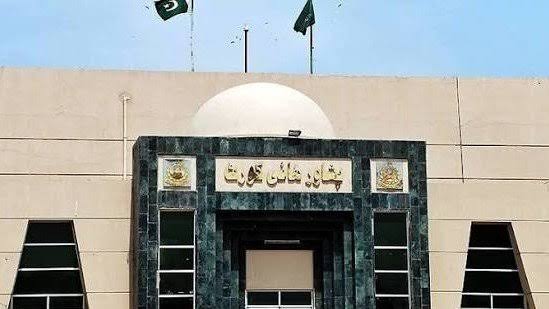
Peshawar High Court (PHC) has temporarily barred law enforcement agencies from arresting or deporting an Afghan cancer patient and two of his family members.
A two-member bench comprising Justice Salahud Din and Justice Qazi Jawad Ehsanullah wrapped up the petition filed by Anar Gul, the patient’s wife, and his son. The judges instructed the family to immediately contact relevant officials for a medical visa or apply to the Ministry of Interior for permission to stay until treatment finishes.
“Upon receipt of such an application, competent authorities shall consider and decide the same expeditiously strictly in accordance with law and on its own merits after taking into consideration the medical condition of petitioner No.1 and material place before them,” the bench stated.
The court granted the 30-day window specifically so the family could pursue legal relief.
“In the meanwhile, having regard to the ongoing medical treatment of petitioner No.1, it is directed that petitioners shall neither be arrested nor deported back to Afghanistan for a period of 30 days from the date of this order, thereby enabling them to avail the remedy as indicated above,” the court order read.
Acknowledging the situation, the bench pointed out that while the family lacks legal status, Gul’s health condition requires urgent attention.
“It is evident that although petitioners presently lack a valid immigration status, their claim is founded upon an ongoing and serious medical condition of petitioner No.1 for which he is receiving specialised treatment at a recognised medical institution in Pakistan,” the judges noted.
The court emphasized that decisions regarding stay extensions rest with executive authorities rather than the judiciary.
“Whether petitioners should be permitted to remain in Pakistan on medical grounds squarely falls within the domain of competent authorities, who are vested with the statutory power to consider such request in accordance with the applicable immigration laws and policy,” the bench stated.
“At this stage, this court considers it appropriate to offer the petitioners an opportunity to avail the remedy available to them under the law by approaching the competent forum rather than the court itself adjudicating upon the merit of such requests in its constitutional jurisdiction,” the order added.
Advocate Imran Khan, representing the family, told the court that his clients lived in Swat on Proof of Registration (PoR) cards, which the government no longer recognizes as valid residency documents.
Khan explained that doctors diagnosed Gul with high-grade B-cell lymphoma affecting the left temporal lobe.
The lawyer explained that Gul underwent treatment at Aga Khan University Hospital in Karachi and currently receives weekly chemotherapy at Shifa International Hospital in Islamabad. Halting treatment at the moment would cause irreversible damage to Gul’s health and put his life on the line.
Khan warned that state agencies had already begun steps to deport the family. Forced return to Afghanistan where specialized cancer care is unavailable due a healthcare crisis would effectively end Gul’s treatment. Khan added that superior courts consistently rule against state actions that endanger human life.
Assistant Attorney General Said Jamil Shah argued that the cancellation of PoR cards leaves the family without legal standing to remain in Pakistan. Shah noted, however, that the petitioners can still apply for a medical visa or seek interior ministry approval to stay until the medical treatment concludes.