
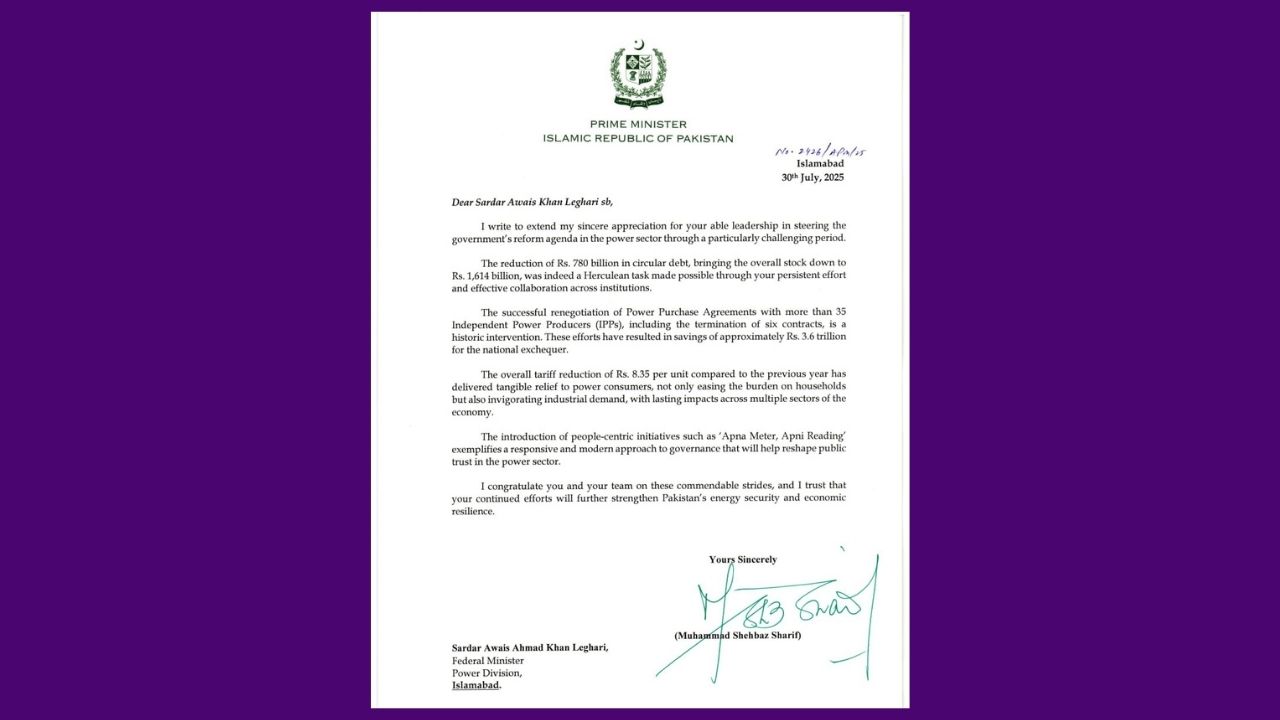


In a rare and high-impact gesture of appreciation, Prime Minister Shehbaz Sharif has officially lauded Federal Minister for Power, Sardar Awais Ahmad Khan Leghari, for his leadership in driving critical reforms in Pakistan’s power sector.
The Prime Minister’s letter of recognition praises the Power Division’s performance, highlighting a combination of fiscal discipline, structural reforms, and people-centric governance under Leghari’s stewardship.
At the heart of the Prime Minister’s appreciation is the unprecedented reduction of Rs. 780 billion in circular debt, a longstanding burden on Pakistan’s economy. The Prime Minister commended this achievement as a testament to strong financial management and inter-ministerial coordination, calling it a “historic breakthrough.”
The letter also references a Rs. 3.6 trillion national savings secured through the renegotiation of agreements with Independent Power Producers (IPPs) — a bold and difficult move that helped stabilize energy payments and restructured liabilities for long-term relief.
In a tangible move toward public relief, the government also introduced a Rs. 8.35/unit reduction in electricity tariffs, benefiting millions of consumers across Pakistan. The Prime Minister acknowledged this as a rare and impactful step, especially in a global economic climate where energy prices continue to rise.
Further, the launch of the ‘Apna Meter Apni Reading’ initiative was hailed as a transformative step toward transparency and consumer empowerment. The initiative allows citizens to directly participate in meter reading, reducing billing disputes and increasing public trust in the power distribution process.
The Prime Minister noted that these reforms were achieved within a short span of time and with institutional collaboration, crediting Minister Awais Leghari’s “commitment, leadership, and reform-focused approach.”
This letter of appreciation marks not only a personal milestone for the Minister but also a national moment of progress, signaling renewed public confidence in the governance of the power sector — one that has long been plagued by inefficiencies and mistrust.
'%3e%3crect%20y='0.445312'%20width='48'%20height='48'%20rx='24'%20fill='white'%20fill-opacity='0.5'/%3e%3crect%20x='0.5'%20y='0.945312'%20width='47'%20height='47'%20rx='23.5'%20stroke='%23808080'/%3e%3cpath%20d='M34.625%2024.4453L14%2024.4453'%20stroke='%23808080'%20stroke-width='0.920053'/%3e%3cpath%20d='M23.375%2034.4453L13.375%2024.4453L23.375%2014.4453'%20stroke='%23808080'%20stroke-width='0.920053'/%3e%3c/g%3e%3cdefs%3e%3cfilter%20id='filter0_b_489_44344'%20x='-12'%20y='-11.5547'%20width='72'%20height='72'%20filterUnits='userSpaceOnUse'%20color-interpolation-filters='sRGB'%3e%3cfeFlood%20flood-opacity='0'%20result='BackgroundImageFix'/%3e%3cfeGaussianBlur%20in='BackgroundImageFix'%20stdDeviation='6'/%3e%3cfeComposite%20in2='SourceAlpha'%20operator='in'%20result='effect1_backgroundBlur_489_44344'/%3e%3cfeBlend%20mode='normal'%20in='SourceGraphic'%20in2='effect1_backgroundBlur_489_44344'%20result='shape'/%3e%3c/filter%3e%3c/defs%3e%3c/svg%3e)
'%3e%3crect%20y='0.445312'%20width='48'%20height='48'%20rx='24'%20fill='white'%20fill-opacity='0.5'/%3e%3crect%20x='0.5'%20y='0.945312'%20width='47'%20height='47'%20rx='23.5'%20stroke='%23808080'/%3e%3cpath%20d='M13.375%2024.4453L34%2024.4453'%20stroke='%23808080'%20stroke-width='0.920053'/%3e%3cpath%20d='M24.625%2014.4453L34.625%2024.4453L24.625%2034.4453'%20stroke='%23808080'%20stroke-width='0.920053'/%3e%3c/g%3e%3cdefs%3e%3cfilter%20id='filter0_b_489_44344'%20x='-12'%20y='-11.5547'%20width='72'%20height='72'%20filterUnits='userSpaceOnUse'%20color-interpolation-filters='sRGB'%3e%3cfeFlood%20flood-opacity='0'%20result='BackgroundImageFix'/%3e%3cfeGaussianBlur%20in='BackgroundImageFix'%20stdDeviation='6'/%3e%3cfeComposite%20in2='SourceAlpha'%20operator='in'%20result='effect1_backgroundBlur_489_44344'/%3e%3cfeBlend%20mode='normal'%20in='SourceGraphic'%20in2='effect1_backgroundBlur_489_44344'%20result='shape'/%3e%3c/filter%3e%3c/defs%3e%3c/svg%3e)