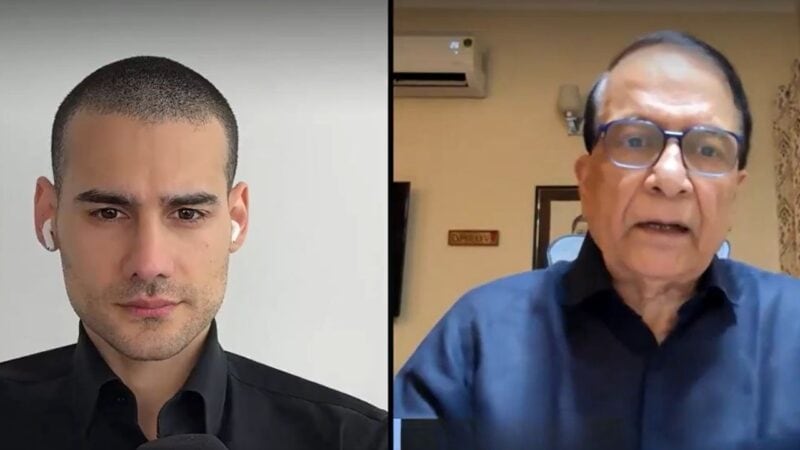
Political commentator and podcast host Mario Nawfal has compared the Pakistan-Kuwait defence cooperation agreement to NATO’s Article 5 Collective Defence Clause and Islamabad’s existing security arrangements with Saudi Arabia, while noting that specific operational details regarding the agreement remain unavailable.
“We don’t have details on whether it’s similar to Saudi, where an attack on Kuwait would be an attack on Pakistan, or something similar to Article 5 in NATO. But it’s… it’s an interesting development,” Nawfal stated.
NATO charter’s Article 5 is a collective defense clause which states that an armed attack on either of the members would be treated as an armed attack on all of the member states.
Appearing as a guest on the show, Indian defence analyst Pravin Sawhney highlighted the alleviated role of Pakistan in the region.
“Mario, this is extremely significant. And this is something that I have been talking about for a very long time,” Sawhney asserted.
He referenced the signing of Islamabad MoU, the visit from Iranian President Pezeshkian to Islamabad on June 23, along with other major official meetings of the regional leaders with Pakistan’s leadership as a reflection of Pakistan’s anchor role in the security architecture of the region.
Sawhney pointed out that Field Marshal Asim Munir traveled to Turkiye on July 14 and 15, where he was received by Turkish President Erdogan at the airport, followed by high-level discussions on defence cooperation and regional structures between both allies.
Further he stated that Pezeshkian viewed “Pakistan to be the anchor of the Islamic framework in West Asia,” adding that the regional goals required “Americans leave West Asia, starting with proximity to Iran, which is the GCC countries.”
“Islamic framework basically means that everything will be something where all the Muslim countries, they align. So instead of having American framework, Islamic framework,” Sawhney noted.
Following Kuwait’s ratification of the arrangement, Sawhney predicted that more GCC countries will join the pact.
“The Qataris will also follow suit, because the Qataris also are in talks with Pakistan. So, the Pakistanis are very much there, and now they have become the anchor of the Islamic framework. So, more and more GCC countries, will be talking with the Pakistanis for this collective security arrangement,” he predicted.
Sawhney explained that the security architecture within the newly drawn framework relied on “indivisible security” or “cooperative security,” which entailed coupling security apparatus of Muslim states with each other. “The security of one should not be at the expense of another,” he pointed out.
“When you talk of collective security, what that means is against outside countries, against countries which are not part of the region, in this case, obviously, the Americans,” Sawhney explained.