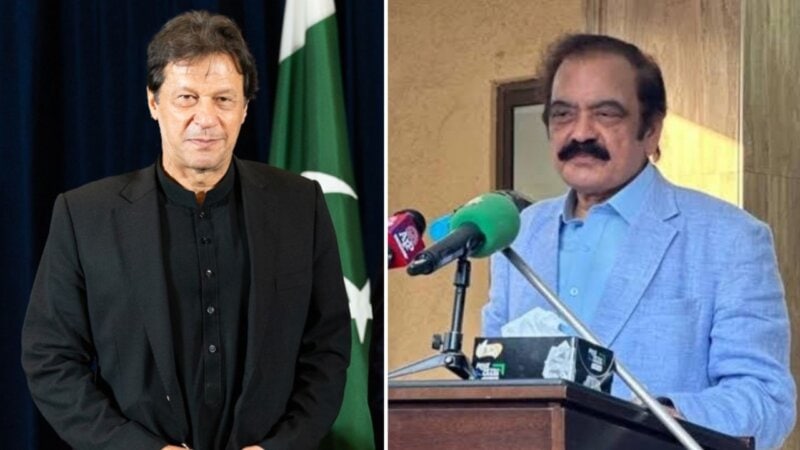
Adviser to the Prime Minister on Political Affairs Rana Sanaullah has rejected speculation that PTI founder Imran Khan’s recent meetings at Adiala jail carry a message about the proposed 28th Constitutional Amendment or the creation of new provinces, saying that the court arranged the meetings after the former prime minister’s lawyers committed to arguing his appeals.
Speaking to Geo News anchor Shahzeb Khanzada, Sanaullah said that the Islamabad High Court (IHC) arranged the meetings after lawyers Salman Safdar and Latif Khosa refused to present arguments in the appeals of Imran Khan and his wife Bushra Bibi in the £190 million case, citing their inability to meet their clients.
“When this appeal was presented for hearing, Salman Safdar Sahab and Khosa Sahab, who are their counsels, refused to argue there. They said that we cannot present arguments in this appeal because we can’t even meet our client,” Sanaullah said.
He added that the chief justice of the IHC offered to arrange a meeting if the lawyers committed to presenting arguments in the case.
“The head of that bench, who is the Chief Justice of the Islamabad High Court, said, ‘If you promise that you will present arguments, then I will arrange your meeting.’ So, as a result of this commitment, permission for this meeting was granted,” Rana stated.
Khanzada questioned Sanaullah about the meetings, pointing out that PTI lawyers had raised the issue of access to Imran Khan before the latest court proceedings but had not secured permission.
He also asked whether the recent meetings indicated a change in the government’s approach towards the PTI founder or reflected developments behind the scenes.
Sanaullah maintained that the court arranged the meetings because of the lawyers’ commitment to argue the appeals. He observed that the court could deliver its judgment within two to four days after the lawyers conclude their arguments.
Khanzada then asked whether the meetings meant the government had received a message from the system to move forward with the creation of new provinces, given PPP’s opposition to the proposal and the government’s position on the matter.
Sanaullah said the judgment on the appeals will clarify the situation and address speculation surrounding the meetings.
Rejecting suggestions that the meetings had any connection with the proposed 28th Amendment, he said, “This was a simple meeting, and it was a meeting of those counsels who made a commitment in court that they would present arguments in that appeal and enable the court to deliver its judgment on the appeal.”
He rejected claims that the meetings involved discussions about the constitutional amendment.
“This political theory that the meeting was arranged for the 28th amendment and that any discussion about the 28th amendment took place, is completely wrong, and there is no such thing,” Sanaullah said.
Meanwhile, Journalist Fakhar Durrani, speaking on Geo News’ Report Card, said the meetings had created an impression that the government had reached some arrangement with the PTI, but maintained that the IHC’s decision to allow the meeting was based on the merits of the case.
“Since Khan’s meeting with his lawyers, there’s a perception that this was due to some deal or arrangement with the PTI. This isn’t the case,” Durrani said, explaining that the court granted permission for the meeting and extended its duration in connection with the ongoing proceedings.
He said that the £190 million case involving Imran Khan and Bushra Bibi had remained pending since January 2025, while the IHC had repeatedly asked the PTI’s lawyers from May onwards to present their arguments so the proceedings could conclude and the court could announce its verdict.
“From May up until now, for seven months, PTI’s lawyers have consistently given them only one reason: that they neither have Imran Khan’s permission to present arguments, nor have they received instructions on whether to contest or argue the case,” he said.
Durrani said the case was now approaching its conclusion and expressed his assessment that Imran Khan and the PTI might not succeed in defending it on its merits, meaning Imran Khan’s sentence could remain intact.
The discussion comes as Interior Minister Mohsin Naqvi has proposed a referendum to determine public opinion on the creation of new provinces or administrative units.
During a visit to the National Cyber Crime Investigation Agency (NCCIA) in Lahore on Thursday, Naqvi urged political parties to consider a public vote, saying that the outcome could settle the debate.
“If people say in a referendum that provinces should be formed, we should go ahead with it. This is the best way to put an end to this debate,” Naqvi told journalists.
He also assured political parties that the government will consult all stakeholders before making any decision, saying, “Nothing will happen against their will. And if anything does happen, it will be after taking everyone into confidence.”
PPP has opposed proposals to create new provinces in Sindh, while Defence Minister Khawaja Asif has argued that Pakistan could have up to 12 provinces if the government bases the exercise on administrative needs rather than linguistic, ethnic or political considerations.