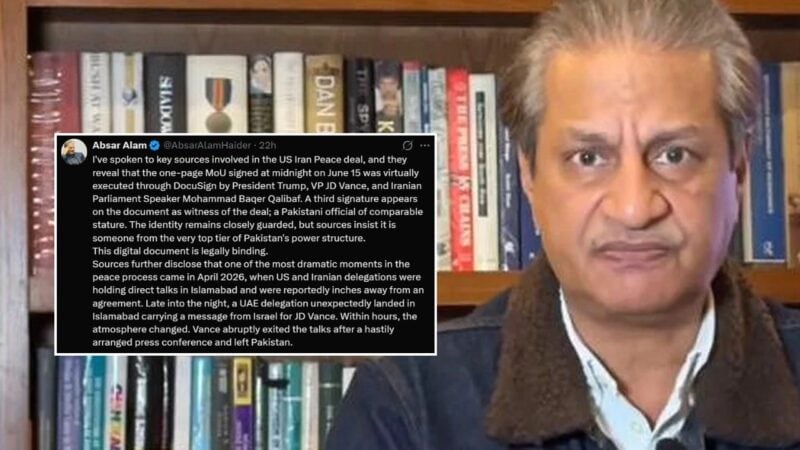
A Pakistani official from the country’s highest tier of power witnessed the signing of the US-Iran peace agreement, journalist Absar Alam reported on X, citing sources with direct knowledge of the deal.
The one-page Memorandum of Understanding (MoU) was signed digitally at midnight on June 15 through DocuSign by United States (US) President Donald Trump, Vice President JD Vance and Iranian Parliament Speaker Mohammad Baqer Qalibaf.
A third signature appears on the document as witness, belonging to a Pakistani official whose identity remains closely guarded. Posting on X, Alam wrote that sources “insist it is someone from the very top tier of Pakistan’s power structure,” adding that the digital document is “legally binding”.
Alam further reported that one of the most critical moments in the peace process came in April 2026, when US and Iranian delegations were holding direct talks in Islamabad and were reportedly on the verge of an agreement.
Late into the night, a UAE delegation unexpectedly arrived carrying a message from Israel for Vance. Within hours, the atmosphere shifted Vance exited the talks following a hastily arranged press conference and left Pakistan.
Alam wrote that “multiple sources say that was one of several moments when Israeli intervention threatened to derail the process,” but that “Islamabad kept the channel alive”.
Behind-the-scenes messaging intensified while public signals also emerged, including Defence Minister Khawaja Asif’s pointed criticism of Israel, alongside indirect messages sent to Tel Aviv until the deal crossed the finish line.
This secret diplomacy underpins the massive regional shift announced by the leaders.
Trump confirmed the immediate lifting of the naval blockade on Truth Social, stating, “I hereby fully authorize the toll free opening of the Strait of Hormuz, and, simultaneously herewith, authorise the immediate removal of the United States Naval blockade,” before adding, “Ships of the World, start your engines. Let the oil flow!”
A senior Iranian official told Reuters that the draft covers nuclear limits, the opening of the Strait, and oil sanction waivers. Iran’s Mehr news agency reported that the 14-point document stipulates “The release of 24 billion dollars in frozen Iranian assets during the 60-day negotiation period,” specifying that “half of this amount must be made available to Iran before the start of the negotiations”. Consequently, Tehran will freeze uranium enrichment.
Iranian President Masoud Pezeshkian confirmed that “The Supreme National Security Council has concluded that the path of dialogue should be pursued,” noting relations are “on the path to resolution”. Iranian Foreign Minister Abbas Araghchi added that “regional security cannot be shaped through eliminating or ignoring Iran”.
Prime Minister (PM) Shehbaz Sharif finalized the timeline on X, confirming the breakthrough.
“Both sides have declared the immediate and permanent termination of military operations on all fronts, including in Lebanon,” Sharif stated, adding that “the official signing ceremony will be on Friday, 19 June in Switzerland.” Sharif credited the US, Iran, Qatar, Saudi Arabia, and Turkiye, noting that “these pre-implementation discussions will lay the foundation for the technical talks.”