
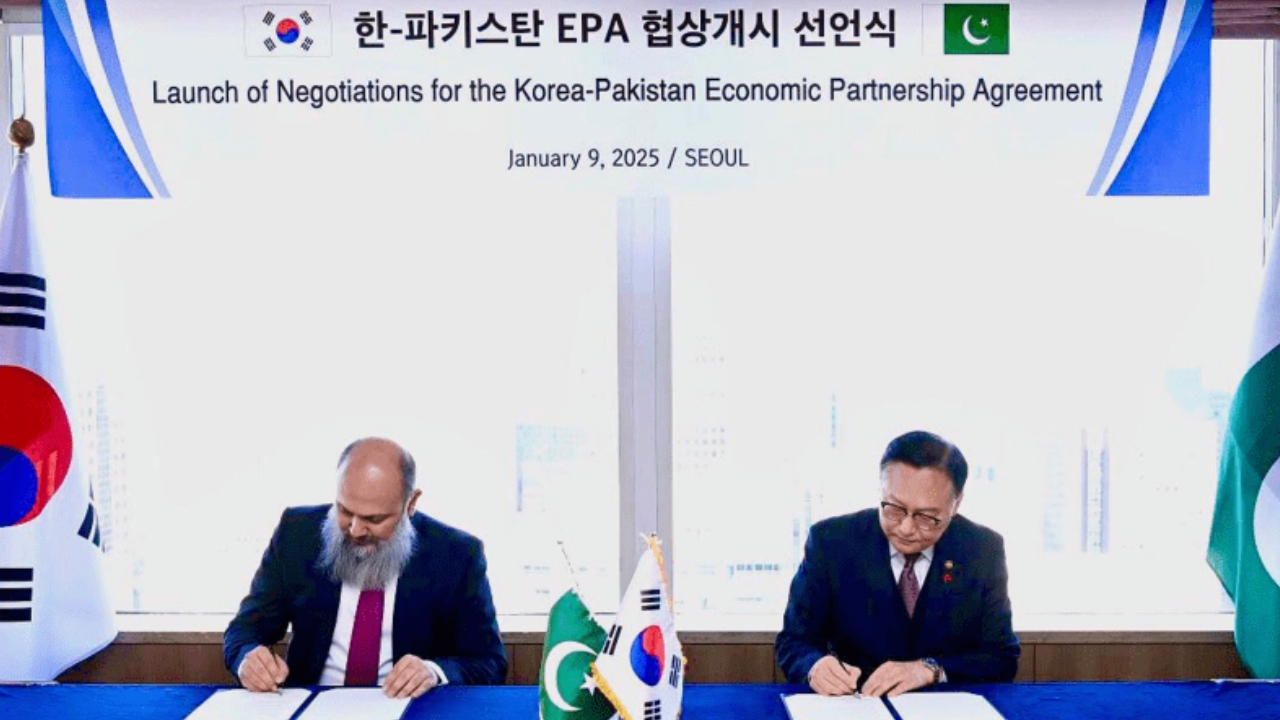


Commerce Minister Jam Kamal Khan attended a high-profile meeting in Seoul, where South Korean Trade Minister Inkyo Cheong proposed an avenue for collaboration to strengthen bilateral economic ties.
Mr. Cheong’s plan effectively serves to shift Korea’s industrial base located in foreign countries to Pakistan. The proposed plan was implemented after dignitaries from both countries had signed the Economic Partnership Agreement (EPA).
Ministers from both countries signed a joint declaration, which would allow for EPA negotiations to begin. Analysts are commenting on how the joint declaration shows that both countries are committed to increasing investment flows, expanding trade and working collaboratively in economic matters.
In an official announcement, the Commerce Ministry claimed that the EPA could promote mutually beneficial trade in goods and services, foster greater ties, and boost economic cooperation. He also stated that bilateral trade stands at $1.3 billion, which could be greatly boosted by the signing of the EPA.
The value of the trade flow is heavily in South Korea’s favour, as Pakistan is not exporting enough to South Korea to equalise the trade deficit between the two countries.
The reason behind this is that South Korea’s primary imports constitute goods such as Mineral fuels as well as electrical and industrial machinery, according to Pangea Logistics Network. These are all goods that Pakistan imports, resulting in Pakistan having little to offer pertaining to trade.
While it may seem that Pakistan has nothing valuable to offer South Korea, the truth is far from that. Mr. Cheong stated that the availability of ‘cost-effective labour’ in Pakistan can benefit both countries.
Essentially, South Korea wants to relocate its industrial base to Pakistan to exploit the fact that wages in Pakistan lag far behind the world average. Moreover, Pakistan is geographically close to ‘high-growth regions’ where South Korea could export its goods after manufacturing them in Pakistan.
After the initial investment, a vast majority of profits generated from industrial activity will be repatriated back to South Korea. While this may seem exploitative as workers will be utilised for being ‘cost-effective’, there are immense benefits to be reaped for Pakistan as well, nonetheless.
According to statistics from the International Monetary Fund (IMF), Pakistan’s current unemployment rate stands at a staggering 7.5 percent. However, with South Korea poised to set up an industrial base in Pakistan, experts predict that the unemployment rate will drop slightly. This is because South Korea’s interest will also positively signal to other countries that Pakistan is a safe destination for their investments.
'%3e%3crect%20y='0.445312'%20width='48'%20height='48'%20rx='24'%20fill='white'%20fill-opacity='0.5'/%3e%3crect%20x='0.5'%20y='0.945312'%20width='47'%20height='47'%20rx='23.5'%20stroke='%23808080'/%3e%3cpath%20d='M34.625%2024.4453L14%2024.4453'%20stroke='%23808080'%20stroke-width='0.920053'/%3e%3cpath%20d='M23.375%2034.4453L13.375%2024.4453L23.375%2014.4453'%20stroke='%23808080'%20stroke-width='0.920053'/%3e%3c/g%3e%3cdefs%3e%3cfilter%20id='filter0_b_489_44344'%20x='-12'%20y='-11.5547'%20width='72'%20height='72'%20filterUnits='userSpaceOnUse'%20color-interpolation-filters='sRGB'%3e%3cfeFlood%20flood-opacity='0'%20result='BackgroundImageFix'/%3e%3cfeGaussianBlur%20in='BackgroundImageFix'%20stdDeviation='6'/%3e%3cfeComposite%20in2='SourceAlpha'%20operator='in'%20result='effect1_backgroundBlur_489_44344'/%3e%3cfeBlend%20mode='normal'%20in='SourceGraphic'%20in2='effect1_backgroundBlur_489_44344'%20result='shape'/%3e%3c/filter%3e%3c/defs%3e%3c/svg%3e)
'%3e%3crect%20y='0.445312'%20width='48'%20height='48'%20rx='24'%20fill='white'%20fill-opacity='0.5'/%3e%3crect%20x='0.5'%20y='0.945312'%20width='47'%20height='47'%20rx='23.5'%20stroke='%23808080'/%3e%3cpath%20d='M13.375%2024.4453L34%2024.4453'%20stroke='%23808080'%20stroke-width='0.920053'/%3e%3cpath%20d='M24.625%2014.4453L34.625%2024.4453L24.625%2034.4453'%20stroke='%23808080'%20stroke-width='0.920053'/%3e%3c/g%3e%3cdefs%3e%3cfilter%20id='filter0_b_489_44344'%20x='-12'%20y='-11.5547'%20width='72'%20height='72'%20filterUnits='userSpaceOnUse'%20color-interpolation-filters='sRGB'%3e%3cfeFlood%20flood-opacity='0'%20result='BackgroundImageFix'/%3e%3cfeGaussianBlur%20in='BackgroundImageFix'%20stdDeviation='6'/%3e%3cfeComposite%20in2='SourceAlpha'%20operator='in'%20result='effect1_backgroundBlur_489_44344'/%3e%3cfeBlend%20mode='normal'%20in='SourceGraphic'%20in2='effect1_backgroundBlur_489_44344'%20result='shape'/%3e%3c/filter%3e%3c/defs%3e%3c/svg%3e)