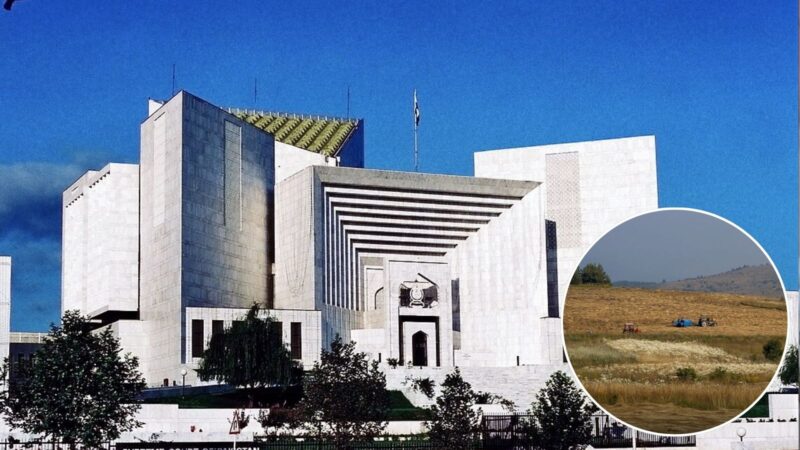
The Supreme Court of Pakistan has ruled that the government can acquire private land without the owner’s consent if the acquisition is meant to serve public interest, while making clear that the power to do so is not unconditional and comes tied to fair compensation.
Justice Muhammad Ali Mazhar authored the judgment and noted that Articles 23 and 24 of the Constitution exist precisely to keep state power in check and maintain a balance between government authority and fundamental rights.
The court observed that property owners must be given “gold for gold, not copper for gold,” meaning the state cannot leave them in a financial crisis or in a worse economic position than before the acquisition.
The verdict stated that land valuation cannot be based only on official government rates.
Authorities are instead required to work out the compensation package by looking at current market values, the land’s potential utility and prospects for future development. The court also noted that if the acquisition process gets delayed, any resulting fluctuation in market prices and inflation must be factored into the final payout.
Under Article 23, every citizen has the right to acquire, hold and dispose of property anywhere in Pakistan, the ruling explained, while Article 24 protects individuals from being deprived of their property except through due legal process.
The court held that the judiciary is bound to act as a guardian of constitutional rights, ensuring that any forced acquisition is linked to a genuine public purpose and matched with just and fair compensation. It added that affected owners are entitled to complete financial justice to make up for the loss they bear for the collective good.
The ruling was issued as the Supreme Court dismissed all appeals filed by the Khyber Pakhtunkhwa (KP) government in a land dispute from Swabi, where the provincial administration had contested a compensation increase awarded to local landowners whose property was taken over for a canal project.
The landowners had gone to court after turning down the initial rates offered by the government.
A reference court later raised the compensation based on the evidence presented, a decision that was subsequently upheld by the Peshawar High Court. The provincial government then approached the Supreme Court to challenge the higher rates, but the apex court rejected all of the state’s objections and upheld the earlier rulings in favor of the landowners.