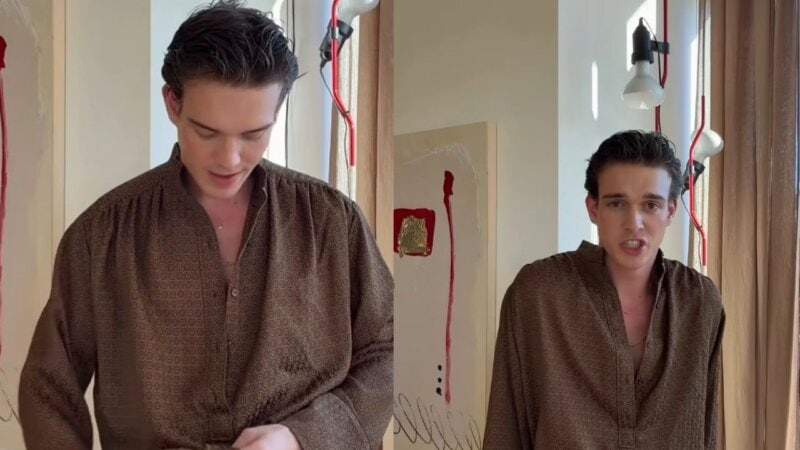
French-Italian content creator and model Luca Mornet sparked online outrage after posting a get-ready-with-me video on Instagram featuring a traditional South Asian shalwar kameez that luxury brand Yves Saint Laurent (YSL) copied and rebranded as Western high fashion.
In the video, Mornet styled a two-piece set from luxury brand SAINT LAURENT for a Sephora event in New York City. The outfit consisted of a long tunic and matching trousers, identical to a classic South Asian shalwar kameez. Mornet sparked immediate backlash by putting on the tunic from the bottom up—stepping into the neck opening like trousers—before pulling it over his shoulders and cinching the waist with a bathrobe-style tie.
Mornet described the ensemble as a top with a bathrobe tie, comparing the silhouette to a “Selemron Jedi” and calling the overall look “chic as f**k.” He finished the outfit with a clutch made from a COS fashion show invitation.
The video highlights a recurring pattern in the global fashion industry, where Western luxury fashion houses repackage traditional South Asian designs as their own creations without proper attribution.
Gucci previously faced massive online backlash for selling a traditional South Asian kurta as an “embroidered linen kaftan” for thousands of dollars, while Prada faced severe criticism for putting traditional khussa footwear on its menswear runway without acknowledging the original artisans.
Social media users quickly recognized the attire as traditional Pakistani and South Asian clothing, taking to the comment section to criticize both Mornet’s wearing method and the luxury brand’s appropriation of cultural garments.
Commenters called out the misrepresentation of the outfit immediately. One user wrote, “This is a kurta and not a top please OH LORD,” while another noted, “That’s a shalwars kameez.” A third viewer simply stated, “Pakistani clothes.”
The method Mornet used to put on the tunic drew intense confusion and annoyance from viewers. “Never seen someone wear a kurta bottom to top,” one user commented. Another asked, “Is it just me who had a problem w how he put on his kurta,” while a third stated, “So no one saw how he wore the kurta?”
Several users accused Mornet of intentionally provoking viewers for views, with one writing, “I’m convinced this sh*t is just rage bait,” and another agreeing, “Stepping into the kurta is straight up rage baiting.” Others pointed out the absurdity of the technique, writing, “Who even wears a kurta like that from the bottom up,” and “First in my bloodline to see a man wearing a belted kurta from the leg up.”
Cultural appropriation and the practice of Western brands rebranding traditional attire dominated the remaining reactions. One user voiced frustration at the styling, asking, “Why are you wearing a belt over a kurta?” Another user stated, “MY CULTURE AINT UR COSTUME,” while one reacted simply with, “aw hell nah.”
Critics also pointed fingers at high-end fashion houses for copying traditional designs without credit. One comment read, “Thats a bloody kurta bro, these high end designer be stealing things from us and calling it high fashion dafuq.” Another user wrote, “Looks really good on you!! But luxury brands should stop colonising cultural clothes! That’s a f*cking Kurta.”
Viewers highlighted the double standards surrounding South Asian fashion in Western spaces. One person commented, “Develop your own god damn designs ysl. And for heaven’s sakes this is so chic? When our men wore it wtf did you people call em?”
Another urged consumers to support authentic makers, stating, “Try buying from original artisans in pakistan rather than these so called luxury brands replicating designs with no context. Also its probably made of polyester and what not. Fashion is not only about wearing the newest runway outfit.”
One post summarized the collective frustration of the audience, writing, “Dear white people…. That’s a kurta pajama not a “chic robe” get it right if you’re going to copy things from other countries and cultures,” while another added, “Don’t piss me off.”