
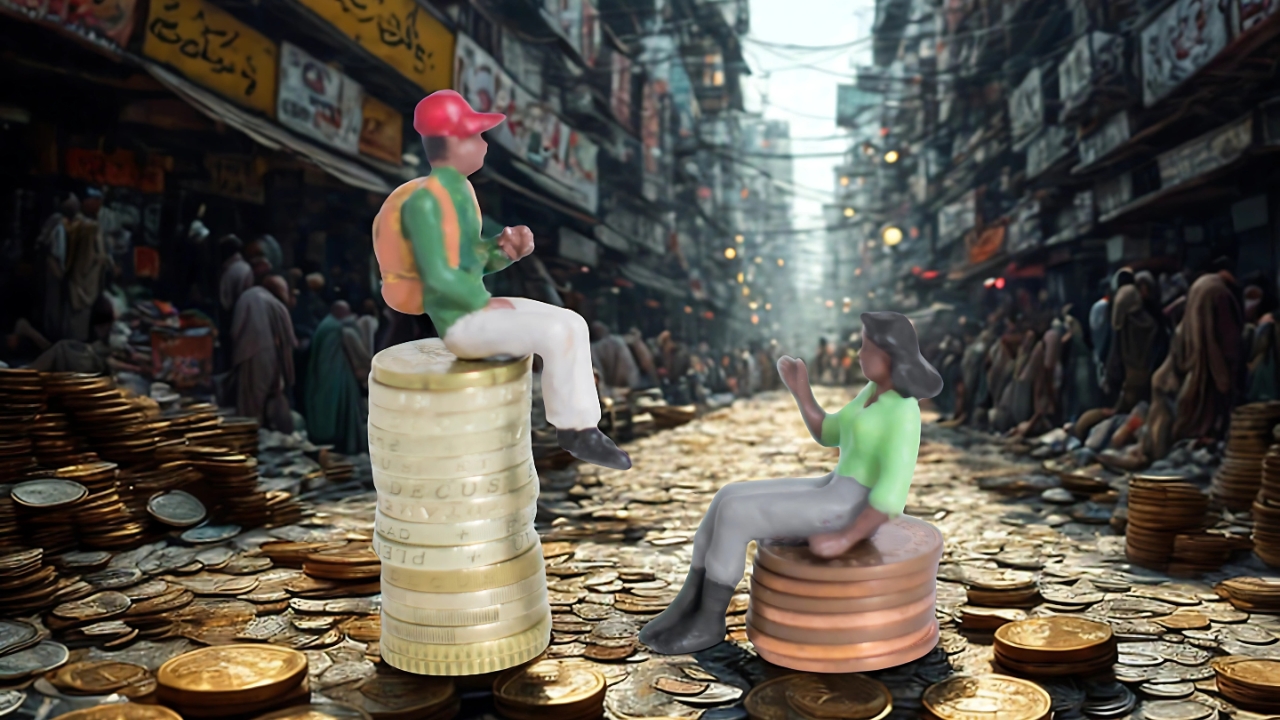


The Karandaaz Financial Inclusion Survey reveals that the proportion of citizens with a bank account or mobile wallet has risen by 28 percent in recent years. However, women remain significantly underrepresented in Pakistan’s formal financial network compared to men.
The data suggests that the increase is primarily a result of an uptick in men signing up for financial services. Women's inclusion, however, has remained subdued.
The data from the survey reveals that female financial inclusion has increased by just 11 percentage points from 2014 to 2024. Meanwhile, financial inclusion of men has seen a more pronounced jump, skyrocketing by 45 percentage points during the same period.
The survey indicates that 35 percent of respondents had access to some form of a digital financial service (DFS) in 2024. This marks a stark improvement from 2014, when access to DFS sat at a measly seven percent. However, details suggest that men’s financial inclusion towers that of women, standing at 56 percent compared to women’s 14 percent.
Findings from the survey were derived from the dataset, which included 6,624 households across various regions of Pakistan. The survey is reportedly intended to outline the disparity in access to DFS by considering underserved groups such as women and those from rural regions of Pakistan.
A region-wise breakdown suggests that Punjab has the highest aggregate level of financial inclusion, sitting at a respectable 40 percent. Islamabad trails close behind at 38 percent, while financial inclusion in Gilgit-Baltistan sits at 33 percent.
However, an intraprovince gender wise comparison shows that the aforementioned average figures are bloated because of higher male financial inclusion.
The gap in the financial inclusion ratio by province is worst in Azad Jammu and Kashmir, where a mere one percent of women have access to financial services, compared to 48 percent of men. Balochistan seems to follow AJK’s trend, with the financial inclusion ratio resting at 4 percent and 41 percent for women and men, respectively.
While the inclusion of women in Punjab, Sindh, Khyber Pakhtunkhwa (KP) and GB is much higher than in AJK and Balochistan, it still rests much lower than men. KP and GB emerge as the most gender-equitable provinces, where the financial inclusion gap between men and women stands at a comparatively lower 20 percentage points.
Reports cite multiple factors behind lower access to financial services for women. These include lower literacy and access to technology. For instance, women lag far behind in SIM card ownership, a necessity to open a bank account. Data suggests that only 47 percent of women have a SIM card registered in their name, highlighting their lower access to technology.
'%3e%3crect%20y='0.445312'%20width='48'%20height='48'%20rx='24'%20fill='white'%20fill-opacity='0.5'/%3e%3crect%20x='0.5'%20y='0.945312'%20width='47'%20height='47'%20rx='23.5'%20stroke='%23808080'/%3e%3cpath%20d='M34.625%2024.4453L14%2024.4453'%20stroke='%23808080'%20stroke-width='0.920053'/%3e%3cpath%20d='M23.375%2034.4453L13.375%2024.4453L23.375%2014.4453'%20stroke='%23808080'%20stroke-width='0.920053'/%3e%3c/g%3e%3cdefs%3e%3cfilter%20id='filter0_b_489_44344'%20x='-12'%20y='-11.5547'%20width='72'%20height='72'%20filterUnits='userSpaceOnUse'%20color-interpolation-filters='sRGB'%3e%3cfeFlood%20flood-opacity='0'%20result='BackgroundImageFix'/%3e%3cfeGaussianBlur%20in='BackgroundImageFix'%20stdDeviation='6'/%3e%3cfeComposite%20in2='SourceAlpha'%20operator='in'%20result='effect1_backgroundBlur_489_44344'/%3e%3cfeBlend%20mode='normal'%20in='SourceGraphic'%20in2='effect1_backgroundBlur_489_44344'%20result='shape'/%3e%3c/filter%3e%3c/defs%3e%3c/svg%3e)
'%3e%3crect%20y='0.445312'%20width='48'%20height='48'%20rx='24'%20fill='white'%20fill-opacity='0.5'/%3e%3crect%20x='0.5'%20y='0.945312'%20width='47'%20height='47'%20rx='23.5'%20stroke='%23808080'/%3e%3cpath%20d='M13.375%2024.4453L34%2024.4453'%20stroke='%23808080'%20stroke-width='0.920053'/%3e%3cpath%20d='M24.625%2014.4453L34.625%2024.4453L24.625%2034.4453'%20stroke='%23808080'%20stroke-width='0.920053'/%3e%3c/g%3e%3cdefs%3e%3cfilter%20id='filter0_b_489_44344'%20x='-12'%20y='-11.5547'%20width='72'%20height='72'%20filterUnits='userSpaceOnUse'%20color-interpolation-filters='sRGB'%3e%3cfeFlood%20flood-opacity='0'%20result='BackgroundImageFix'/%3e%3cfeGaussianBlur%20in='BackgroundImageFix'%20stdDeviation='6'/%3e%3cfeComposite%20in2='SourceAlpha'%20operator='in'%20result='effect1_backgroundBlur_489_44344'/%3e%3cfeBlend%20mode='normal'%20in='SourceGraphic'%20in2='effect1_backgroundBlur_489_44344'%20result='shape'/%3e%3c/filter%3e%3c/defs%3e%3c/svg%3e)