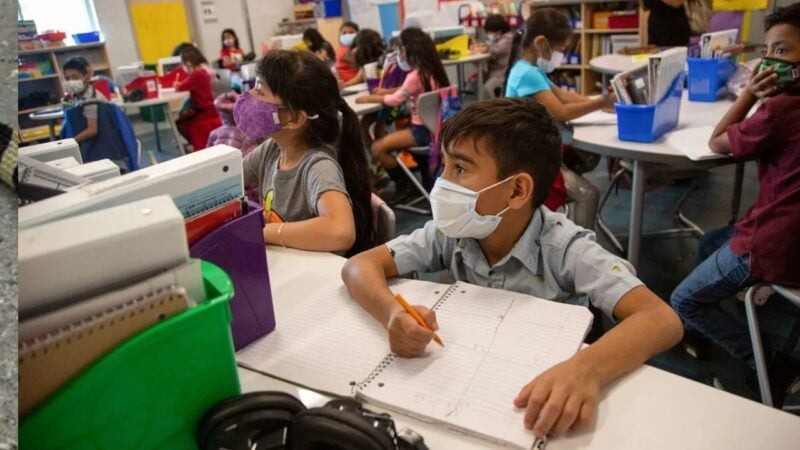
Texas has removed a requirement for high school students to learn about Muslim contributions to algebra and astronomy under newly adopted social studies standards, while adding lessons that critics say give a greater focus to violence and conflict in the teaching of Islam.
The State Board of Education approved the revised standards in June, with the high school changes set to be phased into classrooms from the 2030-31 school year.
The earlier requirement on Muslim contributions to algebra and astronomy was removed during the board’s review of the curriculum. The board also approved lessons on the early history of Islam that describe Prophet Muhammad’s “brutal military campaigns against Jewish and Christian tribes,” the “normalization and regulation of slavery” and the taking of female captives as harem slaves.
The new standards also require students to learn that the Sept. 11 attacks were “motivated by radical Islam”. World history lessons will place 9/11 within the “rise of radical Islam” alongside topics including terrorism, al-Qaeda, the Muslim Brotherhood and ISIS.
History students will also study the roles of former President George W. Bush, former Secretary of State Colin Powell and former National Security Adviser Condoleezza Rice after the attacks. The curriculum includes the US-led wars in Afghanistan and Iraq as well as what the standards describe as the “decline of civil liberties due to the PATRIOT Act”.
The changes have drawn criticism from Muslim students and groups who raised concerns about how Islam will be presented in classrooms.
“I feel attacked, as if my religion doesn’t belong,” 15-year-old Habiba Quresh told board members. “I shouldn’t have to defend my religion in the middle of history class because of one sentence someone on this board wrote.”
Some experts appointed by the board also questioned parts of the material concerning Prophet Muhammad (PBUH).
“I would warn us about including things that are not based on well-established secular sources,” University of Texas at Austin philosophy professor Robert Koons said.
The Council on American-Islamic Relations’ Texas chapter also criticised the removal of Muslim contributions from the curriculum and the new material on Islam.
“The board has turned our classrooms into a place where prejudice is taught as fact and entire communities are written out of their own history,” the organisation said in a statement. “This is not only a Muslim issue, a Black issue, or a Palestinian issue — it is a Texas issue, because a board willing to do this to one community can do it to any community next.”
Board Chair Aaron Kinsey defended the changes and rejected criticism that the new standards would distort the teaching of history.
“There’s been a lot said out of this room, particularly to sensationalize all these topics and to make them seem more divisive than they actually are,” Kinsey told the international media outlet.
The revised standards also introduce lessons on Christianity, including the life and teachings of Jesus and the religion’s influence on Western civilisation and American history. Students will also study the creation of Israel in 1948, the Aztec Empire, President Lyndon B. Johnson’s Great Society and arguments over the “negative effects” of the modern welfare state.
Texas education officials describe the revised standards as a chronological approach to teaching history, designed to give students more context around historical events and ideas.