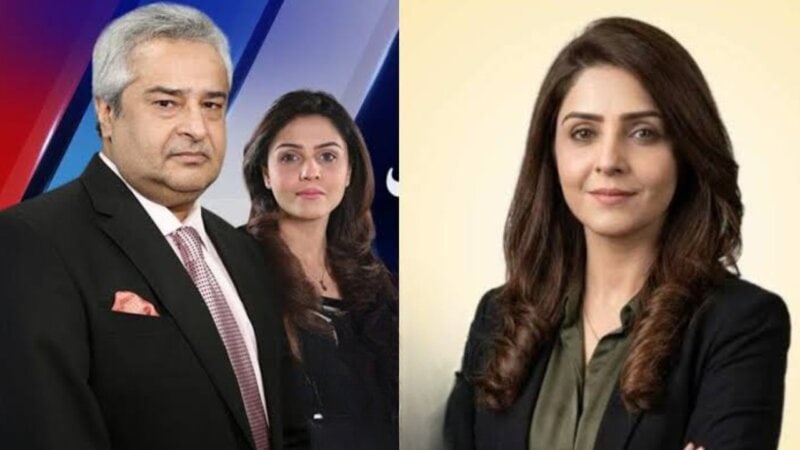
Journalist Amir Mateen has disputed reports that anchorperson Rabia Ahsan had no marital disputes with her husband Muhammad Ahsan, and claimed that she had faced domestic abuse and previously left her home after a dispute with him.
Speaking on his show following Rabia’s death, Mateen said that he knew about the couple’s marital problems through his professional association with her, as they spent several hours together on four days every week, both before and after recording episodes.
“I want to clarify two or three things for sure. First, the news that has been circulating in the media that there was no dispute between them is factually incorrect,” he said.
Mateen claimed that Rabia had been a victim of domestic abuse and remained subjected to it. He said that he had personal knowledge of the situation because of the time he spent with her as a colleague.
He also disclosed that Rabia had left her home following an earlier dispute with her husband and wanted a divorce. According to Mateen, she stayed at a friend’s house for around two months, but her family did not support her.
His account differed from the initial statements given to investigators by Rabia’s family members and a domestic worker after her death. Her family had told police that the couple had no domestic disputes and lived together without conflict.
The domestic worker also told investigators that the couple were packing up clothes at home when they found a .30-bore pistol among the items in a cupboard. According to the worker’s preliminary statement, Ahsan picked up the weapon and waved it in his hand before it went off.
During initial questioning, Ahsan also told police that the gun had fired accidentally and denied any argument or heated exchange with his wife before the incident.
Rabia and Ahsan had been married for 16 years and had two daughters, who were among the family members present at the house when the shooting took place. The daughters, aged 11 and 13, were at the residence along with Rabia’s mother and sister when the gun went off.
Police recorded their initial statements, in which they said that they had not witnessed any dispute between their parents.
Rabia died after sustaining a gunshot wound below her neck at her residence in Rawalpindi. Her brother, Khurram Ahmed, subsequently registered a murder case against Ahsan under Section 302 of the Pakistan Penal Code (PPC) and Section 13-2(a) of the Punjab Arms Amendment Ordinance 2015.
According to the (First Information Report), Khurram received a call from another sister, who informed him about the shooting. She told him that she and their mother had been sitting in the lawn when they heard a gunshot and rushed towards the bedroom, where they found Rabia lying on the floor and Ahsan standing nearby with a pistol.
Police arrested Ahsan and recovered the weapon. Investigators found that the pistol was unlicensed, as he could not produce a licence for it. Police also noted that the weapon was loaded when the suspect allegedly pointed it at his wife.
The initial examination of Rabia’s body found a gunshot wound below her neck. Police said that the absence of blackening marks indicated that the shot had not been fired from close range.
Police had also collected the bullet casing from the crime scene and sent the weapon for forensic analysis.
In a subsequent development, Rabia’s brother decided to withdraw the murder case against her husband, maintaining that her death resulted from accidental firing rather than a deliberate killing.
However, a senior police officer said that the decision did not fall within the police’s authority, as only the trial court could decide whether to accept a request to withdraw the case. The officer stated that police had completed their investigation, arrested the accused and recovered the weapon.
The officer added that any compromise between the complainant and the accused remained subject to the trial court’s decision.