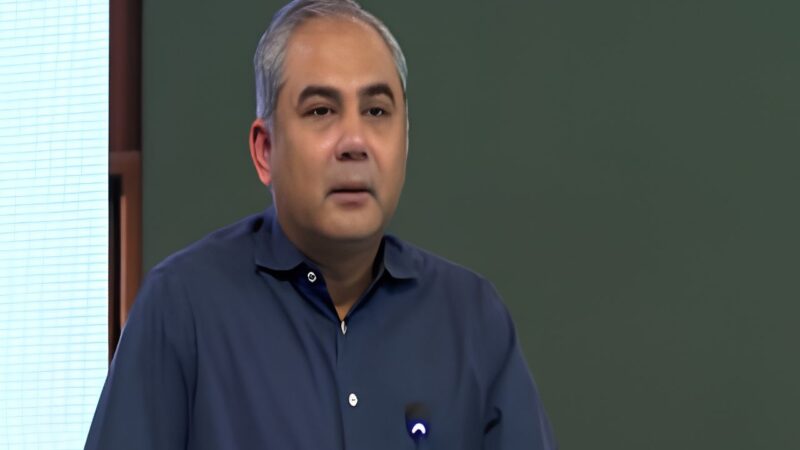
Interior Minister Mohsin Naqvi has said that Pakistan’s current governance framework has collapsed and can no longer resolve the country’s issues, advocating for administrative reforming, including the establishment of new administrative units.
Speaking at the first Pakistan Economic Summit in Islamabad on Thursday, Naqvi commented on the limitations of the existing structure.
“The system we are living under has collapsed. You have been dragging this system for 70 years, and while we all want democracy, there are many forms within democracy. Problems cannot be solved through the current dispensation,” the interior minister said in unusually blunt remarks.
He maintained that the administrative structure requires public engagement to bring about change.
“If this system continues, we will still be sitting here a decade from now discussing the same issues. The only solution is to take [the matter of] administrative units, provinces or whatever you may call it, to the public,” he stated.
Naqvi pointed out that the current setup fails to meet the basic needs of citizens.
“All those who are part of the current political system and fund it are present here. Not everything in this system is bad, but the common man needs the provision of basic services and facilities, which are not delivered,” Naqvi observed.
He opined that people fail to receive timely legal relief despite the creation of new judicial forums, adding that administrative power must reach local levels for the public to access justice.
Talking about the prime minister’s schedule, Naqvi noted that “working for 18 hours a day amounts to firefighting and unless you fix the basics of this country in the democratic spirit, it will continue functioning as it has for 70 years.”
He expressed concern regarding job availability for the country’s youth.
“The youth want only one thing, which is employment on merit, but we are not able to provide opportunities to them; if these cockroaches rise, they can overturn everything,” he said, a reference to the recent protests in India organised by the youth-cebtric Cockroach Janta Party.
The minister warned about the impact of national debt, noting that reliance on foreign loans without structural adjustments will escalate economic problems.
“No matter how many seminars you conduct, the only solution is that political parties sit across the table and set aside their political differences in favour of Pakistan’s national interest,” Naqvi added.
He stated that the business sector must participate directly in economic policy decisions for financial recovery to occur.
Naqvi’s remarks follow recent demands by the Muttahida Qaumi Movement-Pakistan (MQM-P) for the creation of new provinces, particularly in Sindh. The party announced plans to move its campaign to the public domain after using constitutional methods within parliament.
Federal Minister and MQM-P leader Mustafa Kamal reiterated the demand for administrative decentralization beyond the current provincial divisions.
“Pakistan can no longer be run under the current system wherein power devolves only to four provinces,” he underscored.
Kamal asserted that local municipal matters, including waste collection, water supply, road management, sanitation, and town planning, should operate locally rather than under ministerial oversight.