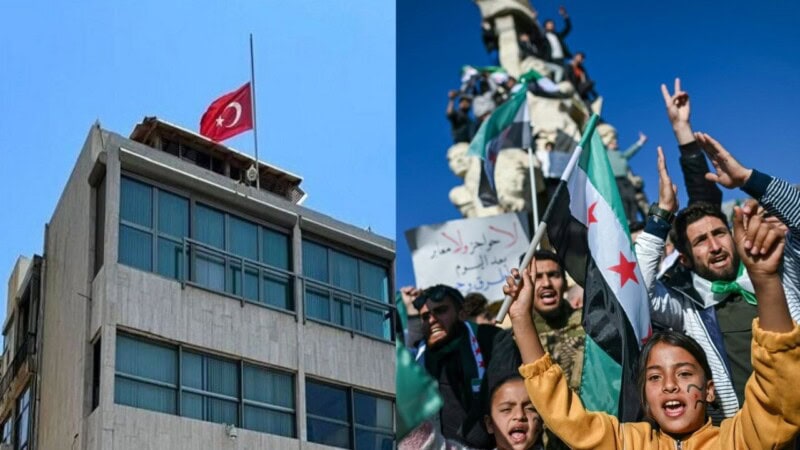
Turkiye is set to reopen its embassy in Damascus on Saturday, nearly a week after President Bashar Assad was toppled by forces backed by Ankara and 12 years after the diplomatic outpost was shuttered early in Syria’s civil war.
The move came as Middle Eastern and Western diplomats gathered in Jordan for high-level talks on Syria, and a day after nationwide celebrations at Assad’s ouster.
Ankara has been a major player in Syria’s conflict, holding considerable sway in the northwest and financing armed groups there, and maintaining a working relationship with the Islamist Hayat Tahrir Al-Sham (HTS), which spearheaded the offensive that brought down Assad.
Turkiye’s Foreign Minister Hakan Fidan said the new charge d’affaires, Burhan Koroglu, left for Syria on Friday, with the embassy expected to be “operational” the following day.
Fidan also said Ankara had urged Assad backers Russia and Iran not to intervene as the Islamist-led militants mounted their lightning advance last week.
“The most important thing was to talk to the Russians and Iranians to ensure that they didn’t enter the equation militarily… They understood,” Fidan told private television network NTV.
Turkish diplomats joined counterparts from the European Union, the United States and the Arab world on Saturday for talks in the Jordanian city of Aqaba.
A day before the meetings in Jordan, Syrians had celebrated what they called the “Friday of victory,” with fireworks heralding the fall of the Assad dynasty.
Celebrations continued into the night on the first Friday — the Muslim day of rest and prayer — since Assad was ousted.
Umayyad Square in Damascus was jammed with vehicles, people and waving flags as fireworks shot into the air, AFPTV footage showed.
Crowds also gathered in the squares and streets of other Syrian cities, including Homs, Hama and Idlib.
UN envoy warns against Syria collapse at crisis talks
Meanwhile, a UN envoy urged foreign powers to work to avoid a collapse of vital Syrian institutions following the downfall of leader Bashar al-Assad, as diplomats gathered in Jordan for a conference on the crisis.
Geir Pedersen, the UN’s special envoy for Syria, also backed a “credible and inclusive” political process to form the next government as he met US Secretary of State Antony Blinken.
“We need to make sure that state institutions do not collapse, and that we get in humanitarian assistance as quickly as possible,” Pedersen said. “If we can achieve that, perhaps there is a new opportunity for the Syrian people.”
Top Arab, Turkish, EU, and US diplomats are holding talks in the Jordanian Red Sea resort city of Aqaba less than a week after Syrian opposition forces toppled al-Assad.
Blinken, on a trip in which he has met the leaders of Jordan, Turkey, and Iraq, has repeatedly called for an “inclusive” process that reflects all the diverse ethnic and religious communities in Syria.
Meeting Pedersen, Blinken said that the United Nations “plays a critical role” in humanitarian assistance and protecting minorities in Syria.