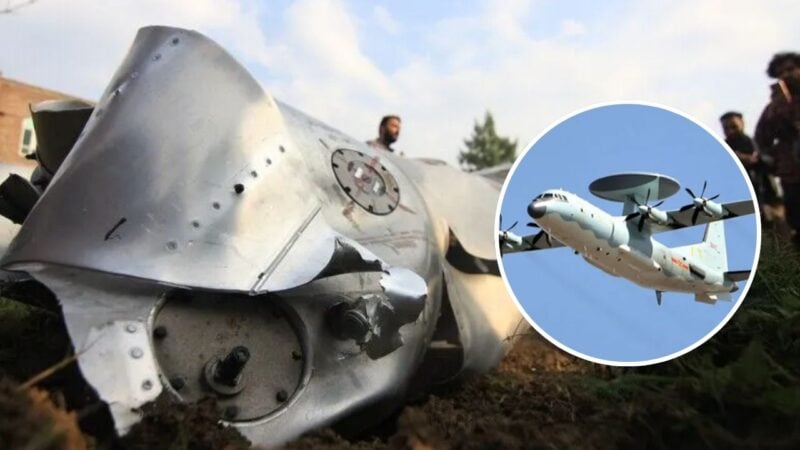
A Ukrainian defense publication has revealed that the Pakistan Air Force (PAF) relied solely on J-10CE fighter radars to hunt Indian aircraft including Rafaels. The discovery upends previous theories suggesting that PAF required continuous assistance of Airborne Early Warning and Control Systems (AEW&C).
Ukrainian publication “Defense Express,” citing an interview of radar developer Ben De from Chinese Central State Television (CCTV), uncovered that Pakistani J-10CE fighter jets successfully targeted Indian aircraft during the May 2025 aerial clash without direct support from Airborne Early Warning and Control (AEW&C) surveillance networks.
Military analysts previously maintained that the operational success of the PAF in the 2025 conflict relied on a coordinated combination of three Chinese components, specifically the ZDK-03 AEW&C aircraft (Chinese-made airborne early warning and control aircraft built specifically for the PAF), the J-10CE fighter, and PL-15 long-range air-to-air missiles.
However, recent disclosures contradicted the prevailing theory, as Ben De, the developer of radar targeting systems and station for the J-10CE claimed that the Pakistan Air Force independently utilized their own KLJ-7A (J-10CE radars) when hunting Indian jets.
He posed that the Pakistani fighter pilots independently searched, detected, captured, and attacked targets at a range of 200 kilometers. All the actions transpired without activating the radar radiation and missile threat warning systems on the Indian Air Force aircraft.
He added that the J-10 aircraft radar KLJ-7A’s specialized algorithms enabled it to execute constant frequency changes across a wide spectrum, apply pulse compression, and mask signal shapes as “noise”.
Consequently, the technological capabilities rendered Russian warning systems on MiG-29 and Su-30MKI aircraft entirely helpless, while similarly bypassing the sophisticated Thales Spectra defence systems installed on French-built Rafales.