
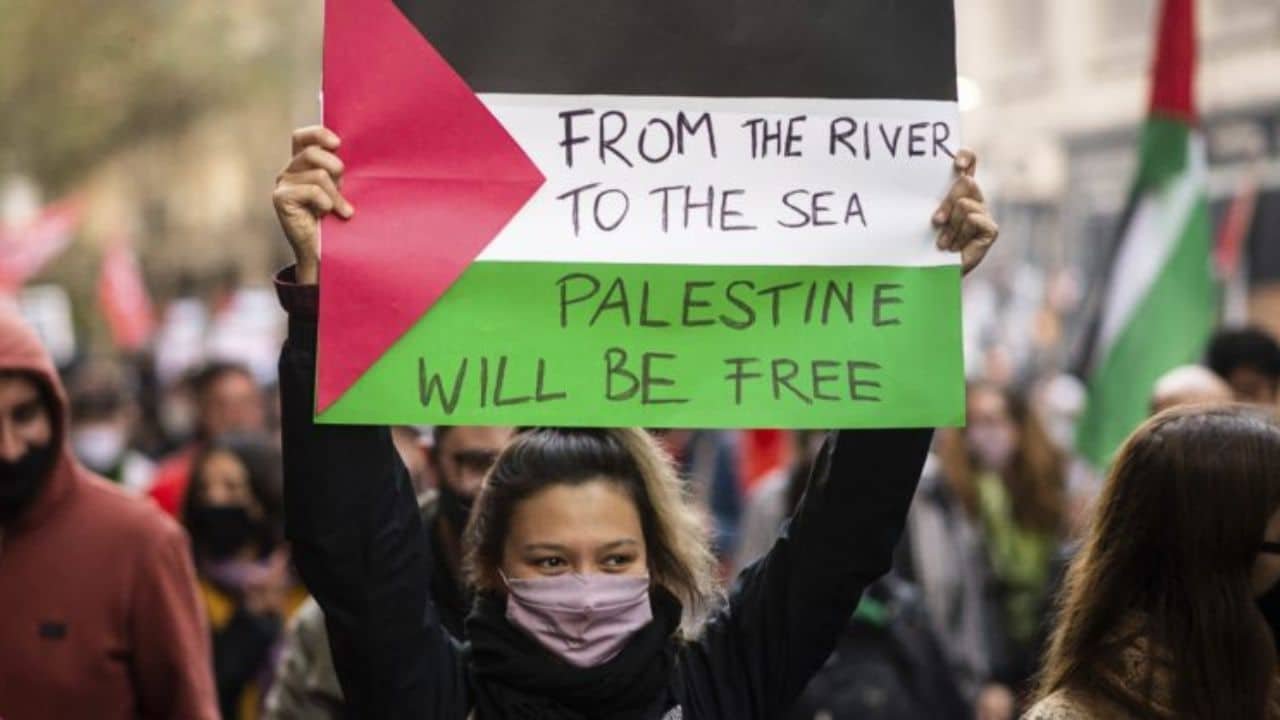


Civilians around the world and human rights activists are staging protests outside US and Israeli embassies demanding an end to the ongoing genocide in Gaza, where the death toll is now about to reach 6,000 — with 2,000 among them children. At protests, the rallying cry is: ‘From the river to the sea, Palestine will be free’. What does this phrase mean and why does it hold so much significance for the Palestinian civilians? We’ll decode it all here.
From the river to the sea,
— yuni✨ (@ayuni_hamdan) October 24, 2023
Palestine will be free 🇵🇸🕊 pic.twitter.com/zGsbliXfX2
The phrase ‘From the river to the sea’ was officially endorsed by the Palestinian Liberation Organisation (PLO) in 1964, which called for a liberated Palestinian state from the Jordan River to the Mediterranean Sea, former Palestinian territories that are currently under forced occupation of Israel.
Since then, the chant has been widely used in pro-Palestinian protests as a demand for the end to the ethnic cleansing of Palestinians by Israel and also that they are handed back their land. However, Zionists have consistently tried to paint it as ‘Anti Semite’ chant by claiming it calls for the genocide of Israeli Jews. A tube driver of the London Underground Train was suspended from his position after a viral video showed him leading the chant ”Free Free Palestine”. Similarly, UK Home Secretary Suella Braverman claimed the chant was ‘anti semitic’, and was “widely understood” to call for the destruction of Israel.
Along with this phrase, another common thing spotted among Palestinian protests is the symbol of a watermelon, which is plastered on flags and posters as protestors condemn the growing death toll in Gaza.
In a few decades, future generations will come across a photo of German protesters sketching a slice of watermelon with "Free Palestine" written on it. What does watermelon have to do with Palestinian freedom? They will ask. The explanation will be that certain authoritarian… pic.twitter.com/Zao5dZnZGy
— طارق حمود (@TarekHamoud) October 19, 2023
The watermelon became a powerful symbol of resistance during 1967 when Israel seized control over the West Bank, Gaza and East Jerusalem, during which the public display of the Palestinian flag was considered a criminal offence.
The symbolic relevance of the watermelon began in 1980 when Palestinian artist Sliman Mansour was arrested by Israeli officials along with Nabil Anani and Issam Badrl as well as their works, because they featured the colours of the Palestinian flag.
“They told us that painting the Palestinian flag was forbidden, but also the colours were forbidden. So Issam said, ‘What if I were to make a flower of red, green, black and white?’, to which the officer replied angrily, ‘It will be confiscated. Even if you paint a watermelon, it will be confiscated,’” Mansour revealed to The National in 2021.
Watermelons were also a popular fruit exported around the world before the Nakba, as Palestinian controlled valleys like the Jordan Valley, Jenin and Arabet Al-Batouf were well known for growing enormous watermelons. Hyperallergic writes after Israeli defence forces drove out Palestinians from their neighbourhoods and brought in their own seed companies, Palestinian watermelons still remained popular due to their size in countries like Lebanon, Jordan and Syria.
Since then, Palestinian artists used the watermelon as a symbol of Palestinian independence to protest against Israel’s illegal occupation. Artists like Khaled Hourani crafted a silkscreen series titled ‘The Story Of The Watermelon’ (2007), which is a series of watermelon slices in front of a white background.
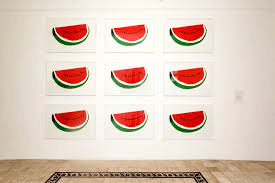
Hourani later went on to co-found the International Art Academy of Palestine along with Mansour and Anani. Speaking about the growing resurgence of the political symbolism behind the watermelon, he was happy at how the Palestinian cause was receiving attention:
“For me, it was kind of sudden. This is just one of my projects, which was not as successful or widespread as it is right now. It’s a unique kind of solidarity… It’s very powerful. I honestly don’t know how to deal with it. Some people are getting it as a tattoo, some are making patterns for clothes, putting it on flags, different mediums. I’m happy that it brings attention to the Palestinian cause.”
Speaking on the rise of social media support for Palestine, Hourani said:
“People around the world are standing up and saying that the occupation has to come to an end. This is a historical moment. As an artist, as a human being, I feel honoured that my work is being used as a tool or is a part of this driving force.”
'%3e%3crect%20y='0.445312'%20width='48'%20height='48'%20rx='24'%20fill='white'%20fill-opacity='0.5'/%3e%3crect%20x='0.5'%20y='0.945312'%20width='47'%20height='47'%20rx='23.5'%20stroke='%23808080'/%3e%3cpath%20d='M34.625%2024.4453L14%2024.4453'%20stroke='%23808080'%20stroke-width='0.920053'/%3e%3cpath%20d='M23.375%2034.4453L13.375%2024.4453L23.375%2014.4453'%20stroke='%23808080'%20stroke-width='0.920053'/%3e%3c/g%3e%3cdefs%3e%3cfilter%20id='filter0_b_489_44344'%20x='-12'%20y='-11.5547'%20width='72'%20height='72'%20filterUnits='userSpaceOnUse'%20color-interpolation-filters='sRGB'%3e%3cfeFlood%20flood-opacity='0'%20result='BackgroundImageFix'/%3e%3cfeGaussianBlur%20in='BackgroundImageFix'%20stdDeviation='6'/%3e%3cfeComposite%20in2='SourceAlpha'%20operator='in'%20result='effect1_backgroundBlur_489_44344'/%3e%3cfeBlend%20mode='normal'%20in='SourceGraphic'%20in2='effect1_backgroundBlur_489_44344'%20result='shape'/%3e%3c/filter%3e%3c/defs%3e%3c/svg%3e)
'%3e%3crect%20y='0.445312'%20width='48'%20height='48'%20rx='24'%20fill='white'%20fill-opacity='0.5'/%3e%3crect%20x='0.5'%20y='0.945312'%20width='47'%20height='47'%20rx='23.5'%20stroke='%23808080'/%3e%3cpath%20d='M13.375%2024.4453L34%2024.4453'%20stroke='%23808080'%20stroke-width='0.920053'/%3e%3cpath%20d='M24.625%2014.4453L34.625%2024.4453L24.625%2034.4453'%20stroke='%23808080'%20stroke-width='0.920053'/%3e%3c/g%3e%3cdefs%3e%3cfilter%20id='filter0_b_489_44344'%20x='-12'%20y='-11.5547'%20width='72'%20height='72'%20filterUnits='userSpaceOnUse'%20color-interpolation-filters='sRGB'%3e%3cfeFlood%20flood-opacity='0'%20result='BackgroundImageFix'/%3e%3cfeGaussianBlur%20in='BackgroundImageFix'%20stdDeviation='6'/%3e%3cfeComposite%20in2='SourceAlpha'%20operator='in'%20result='effect1_backgroundBlur_489_44344'/%3e%3cfeBlend%20mode='normal'%20in='SourceGraphic'%20in2='effect1_backgroundBlur_489_44344'%20result='shape'/%3e%3c/filter%3e%3c/defs%3e%3c/svg%3e)