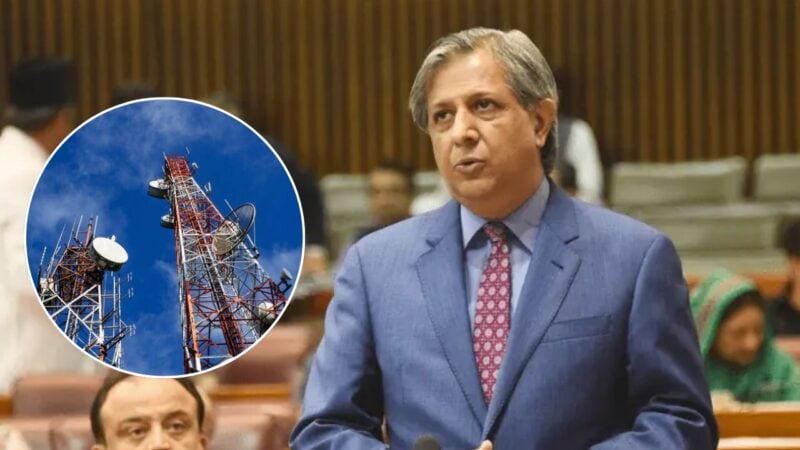
Law Minister Azam Nazeer Tarar has pushed back against the growing controversy surrounding the Pakistan Telecommunication Reorganisation (Amendment) Bill 2026, saying that the uproar was driven by senior journalists who felt that the topic is trending in the news cycle and decided to keep the story running.
On the substance of the bill, Tarar told members of the media on Monday that the legislation was not intended to give the state or telecom companies power over private property.
“It was never the intention that private properties, people’s homes or shops would be taken over, that cables would be laid through them, or towers would be installed on them. This was never the intention, is not the intention, and will not be the intention,” he said.
Tarar acknowledged that confusion arose from how the bill’s safeguards were written, spread across different sections rather than in a consolidated manner, which led to interpretations suggesting private property could be affected.
He said that two interim meetings had already taken place on the prime minister’s directive and a sub-committee had been formed to resolve outstanding issues. “Your private properties, your homes, shops, individuals’ or companies’ properties cannot have any activity carried out there without their consent,” he said.
Journalist Rauf Klasra was among the first to respond.
In a post on X, he laid out the contradiction in Tarar’s position point by point: Prime Minister Shehbaz Sharif had taken notice of the bill and formed an 11-member committee to fix it, while IT Minister Shaza Fatima Khawaja had publicly acknowledged mistakes in the bill and said that the language would be corrected. The PPP had said that it would not support the bill in its current form in the Senate and yet, according to the law minister, none of this constituted a real story.
“It was an issue concerning the property rights of 250 million people, but it wasn’t such a big news story,” Klasra wrote sarcastically. “This is journalistic mischief according to our law minister.”
Others were sharper. One commentator said that the first communication tower should be installed at the IT minister’s house and the first practical experiment should be conducted on the properties of cabinet members, not the public.
Another pointed directly at Tarar’s own role: “Every proposed bill goes to the Ministry of Law before receiving cabinet approval and being presented in the assembly. It is regrettable that the Law Minister was unaware of the Right to Property.”
One social media user was blunt: “When someone seizes a property, which law will protect the property owner on the basis of intention?”
Others were less measured. “A government exhibiting such a level of flawed thinking, utterly unbelievable negligence and complete ignorance of fundamental human rights has perhaps never before been imposed on our beloved homeland,” one post read.
Some called out corporate influence on the bill’s drafting altogether. “I don’t think the rest of the members who looked at the bill are stupid that they cannot understand,” one user observed. “Please don’t fool us and instead of drumming the ‘husun of democracy,’ stop big companies lobbying and bribing for such unjust bills that are oppressive.”