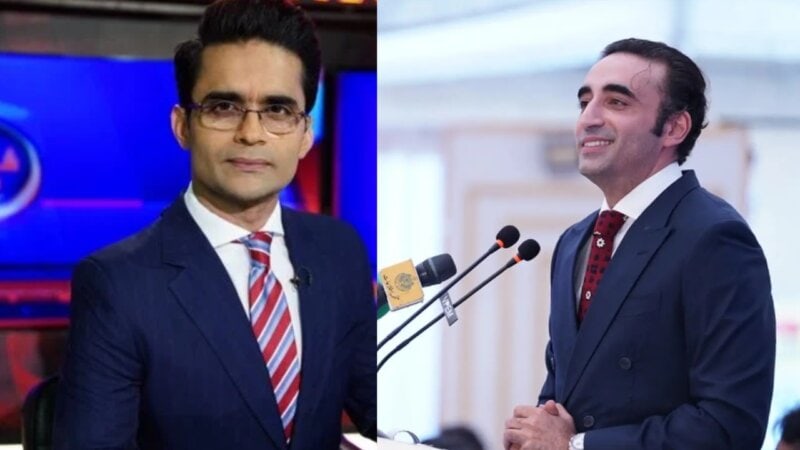
Pakistan Peoples Party (PPP) Chairman Bilawal Bhutto Zardari pushed back against questions about his party’s 18-year rule in Sindh during an interview with Geo News anchor Shahzeb Khanzada, defending his government’s performance while warning that any attempt to divide the province through force could trigger a law and order crisis.
The programme also saw an exchange between the two after Khanzada continued questioning Bilawal over his government’s performance and political positions. During the programme, Khanzada questioned Bilawal over Karachi’s performance, the absence of a Safe City project, education indicators and the province’s development, while Bilawal argued that the federal government had failed to provide Sindh with its due financial resources and that the proposed creation of new provinces ignored the province’s political and ethnic sensitivities. The PPP Chairman evaded questions by Khanzada and said that he was prepared to discuss facts and ground realities.
“If you want to talk about facts, if you want to talk about reality, I am ready to have that conversation. If you want to do politics, then Shahzeb bhai, I can do better politics than you,” Bilawal said.
Khanzada responded that Bilawal could certainly do better politics than him, maintaining that he was asking questions about the PPP government’s performance and was neither interested in nor engaged in politics.
The exchange grew tense as Khanzada questioned Bilawal over his satisfaction with the PPP government’s performance after 18 years in power, pointing out that Karachi ranked 170th among 173 cities in a global ranking, placing it among the three worst cities in the world.
“Karachi is one of the three worst cities in the world ranked 170th out of 173 behind Dhaka, Tripoli, and even Damascus, where, along with Libya and, as we see, Syria, have been through eyars of war,” Khanzada said, questioning whether Bilawal could remain satisfied with the state of the city after nearly two decades of PPP rule.
Bilawal acknowledged that his government had carried out work but admitted that there was room for improvement.
“I believe we have done a lot of work. There is a lot of room for improvement, and there are no two opinions about that,” he said.
He questioned the federal government’s approach towards the creation of new provinces, arguing that political leaders could not be expected to remain silent when the government had already announced its decision.
“If a decision has already been made, then what is the debate for? If a decision has already been made, then what objection could there be to me speaking or giving my opinion?” Bilawal said.
On Karachi’s law and order situation, Khanzada pointed out that Punjab had introduced Safe City projects in 43 cities, while Khyber Pakhtunkhwa (KP) had introduced the system in three cities. He questioned why Sindh had failed to establish a similar project in Karachi despite repeated promises from the PPP over the years.
Bilawal responded by questioning whether authorities could compare Karachi with other Pakistani cities without considering its population and administrative structure.
He said that four separate institutions, including the Karachi Metropolitan Corporation (KMC), Sindh government, Karachi Port Trust (KPT) and Defence Housing Authority (DHA), exercised control over different parts of the city.
He also maintained that his government used modern technology and that the current camera system had helped authorities identify traffic violations.
Bilawal further argued that the performance of his government remained a matter for voters rather than political officeholders to decide.
Khanzada also raised education indicators, citing UNICEF figures showing that 44 percent of children aged five to 16 in Sindh remained out of school, compared with 27 percent in Punjab, 34 percent in KP and 69 percent in Balochistan. He also pointed to Sindh’s slow progress in reducing child stunting.
Bilawal attributed part of the province’s education challenges to recurring floods, saying that the 2022 floods damaged or destroyed 50 percent of Sindh’s educational institutions. He added that floods in 2010 had also affected the province’s education infrastructure.
He stated that the Sindh government rebuilt schools after the 2010 floods, while the federal government provided Rs5 billion after the 2022 floods to improve educational institutions.
Bilawal also accused the federal government of withholding provincial resources, claiming Sindh had not received Rs1.7 trillion due to it from the petroleum levy.
On the proposed division of Sindh, Bilawal warned that an attempt to create new provinces through an unconstitutional process could revive ethnic tensions and undermine the peace that the province had achieved.
“I wasn’t threatening anyone; I was ringing an alarm bell about what the situation is in my province,” he said during the programme.
He argued that Sindh’s history and political circumstances differed from those of Punjab and questioned whether a referendum campaign advocating the province’s division could proceed without creating law and order problems.
He also questioned the credibility of a referendum when Pakistan’s electoral process itself faced disputes.
“The Constitution is clear on how to create new provinces,” he said, arguing that the government should follow the constitutional procedure instead of pursuing a referendum.
The PPP chairman also rejected comparisons between political debates over the division of Punjab and Sindh, saying the two provinces had different histories of ethnic tensions.
“I am a democratic party; I will not pick up weapons. But the ethnic fault lines that exist in this province, they are there,” he said.
After Khanzada’s persistent questioning on the lack of development in Sindh compared to other provinces, Bilawal attacked GEO News, accusing the channel of focusing only on Lahore and not on other provinces. Khanzada responded that neither he, nor GEO News was an ally of the PMLN government, but PPP was the ally of the federal government. Khanzada also added that Bilawal was getting personal and did not like Khanzada’s questions.
Bilawal’s appearance in the programme came a day after he called for a political reset and opposed the creation of new provinces at a ‘Meet the Press’ event at the Karachi Press Club on Tuesday.
During the event, Bilawal had also questioned the government’s decision-making process in remarks to journalist Asma Shirazi, saying that announcing a decision did not mean authorities could impose it without considering its consequences.
“The power of kun fayakun belongs only to Allah Almighty, to no one else,” he said, warning that decisions taken without political consensus could affect society, the federation, politics and people’s lives.