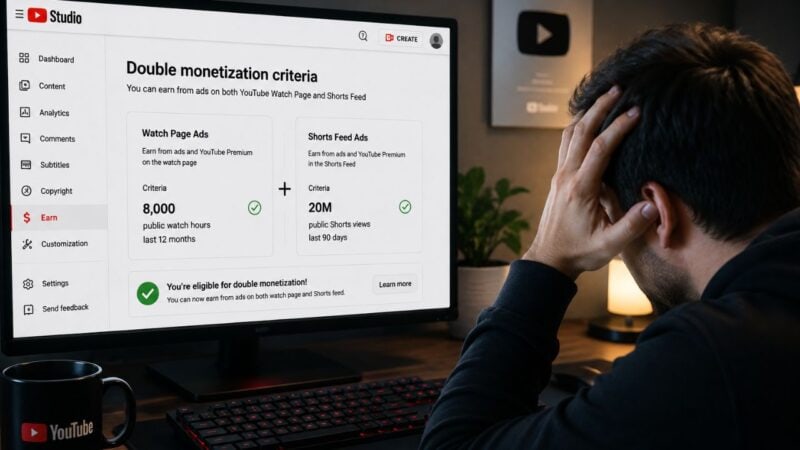
YouTube is doubling the entry requirements for its Partner Program, making it significantly harder for new creators to start earning money on the platform from February 1, 2027.
Under the new rules, creators applying to monetise their channel through the YouTube Partner Program (YPP) will need at least 1,000 subscribers along with either 8,000 qualified watch hours over the past year or 20 million qualified Shorts views in the last 90 days.
This marks a doubling of both current thresholds, which stand at 4,000 watch hours or 10 million Shorts views alongside the same 1,000 subscriber requirement.
Other than the higher entry bar, YouTube is changing how it pays out Shorts revenue. Beginning February 1, 2027, creators will need to maintain 10 million qualified Shorts views over a rolling 90-day period to remain eligible for ads and subscription revenue sharing on Shorts.
Channels that fall below this threshold will not be removed from the Partner Program and will keep earning from their long-form content, with Shorts revenue resuming automatically once views cross 10 million again.
Existing members of the Partner Program are exempt from the new entry thresholds, but they must review and accept updated terms in YouTube Studio by January 31, 2027, to keep earning from their content.
They will also need to maintain either 1,000 watch hours over the past year, 1 million Shorts views, or two long-form videos or five Shorts uploaded every 90 days to stay active in the programme.
It may be noted that YouTube already removes creators who go six months without uploading a video or posting to their feeds.
However, the entry requirements for YouTube’s Fan Funding tools and YouTube Shopping remain unchanged. Creators can still access those features with 500 subscribers, three public uploads within 90 days, and either 3,000 watch hours or three million Shorts views.
YouTube is also expanding its cheaper Premium Lite subscription to every country where it currently offers YouTube Premium. Premium Lite provides an ad-free experience on most videos along with offline downloads and background playback.
Subscription revenue is split between creators based on watch time and views, with 55 percent allocated to long-form videos and 45 percent to Shorts.
“With these additional subscribers, creators can expect higher earnings: when a user signs up for Premium, partners, on average, earn more than when the user was watching ads,” YouTube said in a statement.
In its announcement, YouTube also said the changes are meant to keep pace with the platform’s growth, pointing to more than 200 billion daily Shorts views and over a billion hours of watch time on TV screens every day. The company said it expects to pay creators more in 2027 than it did in 2026 as a result of the changes.
The update comes as YouTube pushes further into premium, TV-style programming to compete with Netflix, HBO Max and Disney Plus, having struck deals this year to carry shows from names like Trevor Noah and rolled out a feature letting creators organize videos into seasons.