
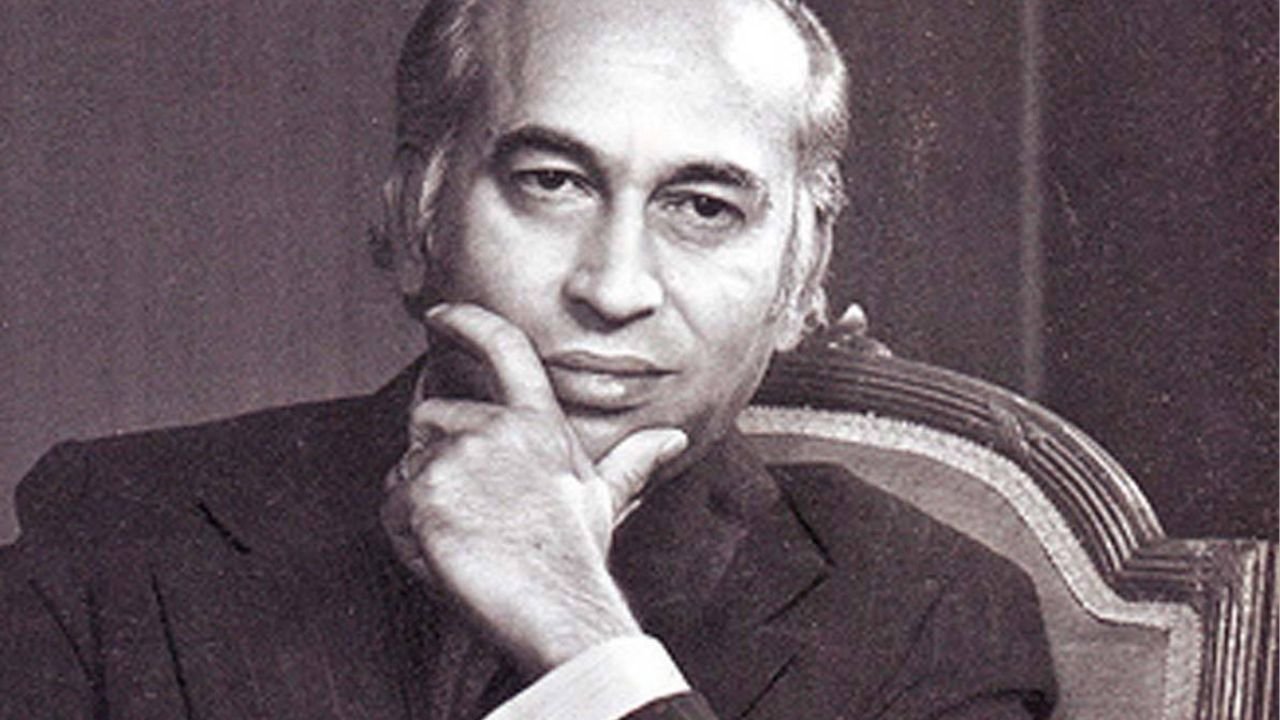


A nine-member bench of the Supreme Court has reserved its verdict on the murder trial of PPP founder and former Prime Minister Zulfiqar Ali Bhutto.
The Chief Justice of Pakistan, Qazi Faez Isa, has said on Wednesday, “The proceedings of the Lahore High Court and of the appeal by the Supreme Court of Pakistan don’t meet the requirement of the fundamental right to fair trial and due process enshrined in the articles 4 and 9 of the constitution.”
“This court can’t reappraise the evidence and undo the decision of the case. However, in a detailed reason, we shall identify the major Constitutional and legal lapses that occurred with regard to fair trial and due process.”
Talking to media outside the court, Bhutto’s grandson, PPP Chairman Bilawal Bhutto Zardari said that the court has acknowledged that his grandfather was not given a fair trial.
What is the Zulfiqar Ali Bhutto case?
Zulfiqar Ali Bhutto, the leader who saw his elected government toppled by General Zia-ul-Haq in 1977, faced a controversial trial resulting in his execution.
Former president Asif Ali Zardari brought back the long-dormant presidential reference on the death sentence of the late Prime Minister Zulfikar Ali Bhutto.
The reference, filed in 2011 under Article 186 of the Constitution of Pakistan, resurfaced as a 9-member Supreme Court bench, led by Chief Justice Qazi Faez Isa, took up the case on December 12.
The reference is based on the assertion by former Supreme Court Chief Justice Naseem Hasan Shah that the trial bench was influenced by the Zia-ul-Haq government.
It also questions the constitutionality of conducting the murder case in the Lahore High Court instead of the Sessions Court.
Article 186 and the President’s right
Article 186 of the National Constitution empowers the President to seek the Supreme Court’s opinion on matters of public importance.
The current hearing revolves around five crucial questions posed by Asif Zardari, aiming to address issues related to human rights, judicial precedent, fairness of the death sentence, adherence to Quranic orders, and the sufficiency of evidence.
Questions from presidential reference
Asif Ali Zardari’s reference poses pivotal questions, challenging the legality and fairness of Bhutto’s trial:
- Were Bhutto’s human rights, as enshrined in the constitution, respected during the trial?
- Will the Supreme Court’s decision set a precedent for all high courts, as per Article 189?
- Was the death sentence impartial and free from bias?
- Does the death penalty align with Quranic principles?
- Was the evidence and testimony presented during the trial sufficient for conviction?
What was the case?
Bhutto, who served as President of Pakistan from 1971 to 1973 and later as Prime Minister until 1977, was at the center of a storm of controversy that ultimately cost him his life.
The narrative begins with the fall of Dhaka in December 1971, which marked a significant turning point in Pakistan’s history. Following this, Bhutto rose to power, first as President and later as Prime Minister under the newly established 1973 Constitution.
However, his reign was short-lived as General Zia-ul-Haq seized control through a martial law imposition on July 5, 1977.
Bhutto’s troubles escalated when he was arrested on September 3, 1977, in connection with the murder of political opponent Nawab Muhammad Ahmad Khan Kasuri in March 1974.
Despite being released just ten days later due to “contradictory and incomplete” charges, Bhutto found himself back behind bars, this time under martial law. His trial commenced on October 24, 1977, with allegations of conspiracy to murder hanging over his head.
Masood Mahmood, the Director General of the Federal Investigation Agency, testified against Bhutto, claiming he had ordered Kasuri’s assassination.
The trial was marred by interruptions and allegations of bias, culminating in Bhutto’s conviction for murder on March 18, 1978. Despite appeals and pleas for clemency, Bhutto’s fate was sealed when the Supreme Court upheld the verdict on February 6, 1979.
The final blow came on March 24, 1979, when the Supreme Court dismissed Bhutto’s appeal, clearing the way for his execution. Bhutto’s appeal in the Supreme Court in front of a seven-member bench was dismissed with a 4-3 verdict against him in February 1979.
General Zia-ul-Haq, who had been calling Bhutto a murderer throughout the trial, ordered his hanging on April 4, 1979, sparking widespread condemnation and accusations of judicial misconduct.
'%3e%3crect%20y='0.445312'%20width='48'%20height='48'%20rx='24'%20fill='white'%20fill-opacity='0.5'/%3e%3crect%20x='0.5'%20y='0.945312'%20width='47'%20height='47'%20rx='23.5'%20stroke='%23808080'/%3e%3cpath%20d='M34.625%2024.4453L14%2024.4453'%20stroke='%23808080'%20stroke-width='0.920053'/%3e%3cpath%20d='M23.375%2034.4453L13.375%2024.4453L23.375%2014.4453'%20stroke='%23808080'%20stroke-width='0.920053'/%3e%3c/g%3e%3cdefs%3e%3cfilter%20id='filter0_b_489_44344'%20x='-12'%20y='-11.5547'%20width='72'%20height='72'%20filterUnits='userSpaceOnUse'%20color-interpolation-filters='sRGB'%3e%3cfeFlood%20flood-opacity='0'%20result='BackgroundImageFix'/%3e%3cfeGaussianBlur%20in='BackgroundImageFix'%20stdDeviation='6'/%3e%3cfeComposite%20in2='SourceAlpha'%20operator='in'%20result='effect1_backgroundBlur_489_44344'/%3e%3cfeBlend%20mode='normal'%20in='SourceGraphic'%20in2='effect1_backgroundBlur_489_44344'%20result='shape'/%3e%3c/filter%3e%3c/defs%3e%3c/svg%3e)
'%3e%3crect%20y='0.445312'%20width='48'%20height='48'%20rx='24'%20fill='white'%20fill-opacity='0.5'/%3e%3crect%20x='0.5'%20y='0.945312'%20width='47'%20height='47'%20rx='23.5'%20stroke='%23808080'/%3e%3cpath%20d='M13.375%2024.4453L34%2024.4453'%20stroke='%23808080'%20stroke-width='0.920053'/%3e%3cpath%20d='M24.625%2014.4453L34.625%2024.4453L24.625%2034.4453'%20stroke='%23808080'%20stroke-width='0.920053'/%3e%3c/g%3e%3cdefs%3e%3cfilter%20id='filter0_b_489_44344'%20x='-12'%20y='-11.5547'%20width='72'%20height='72'%20filterUnits='userSpaceOnUse'%20color-interpolation-filters='sRGB'%3e%3cfeFlood%20flood-opacity='0'%20result='BackgroundImageFix'/%3e%3cfeGaussianBlur%20in='BackgroundImageFix'%20stdDeviation='6'/%3e%3cfeComposite%20in2='SourceAlpha'%20operator='in'%20result='effect1_backgroundBlur_489_44344'/%3e%3cfeBlend%20mode='normal'%20in='SourceGraphic'%20in2='effect1_backgroundBlur_489_44344'%20result='shape'/%3e%3c/filter%3e%3c/defs%3e%3c/svg%3e)