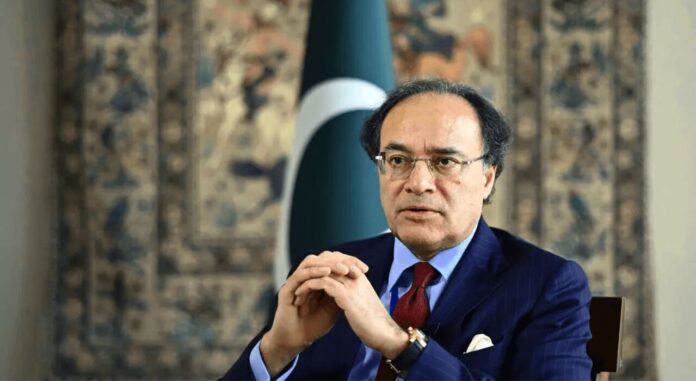
Finance Minister Muhammad Aurangzeb has expressed confidence that the International Monetary Fund (IMF) Executive Board will approve a $1.2 billion loan tranche for Pakistan during its Friday meeting.
Briefing the National Assembly Standing Committee on Finance and Revenue, chaired by Syed Naveed Qamar, the minister said that the country’s macroeconomic indicators are on track despite regional instability and external pressures.
Aurangzeb noted that the government intends to maintain fiscal policies and structural reforms to sustain stability and boost investor confidence.
Data presented to the committee highlighted growth in exports, remittances and IT services. Aurangzeb said that Pakistan was expected to maintain a current account surplus, with foreign exchange reserves projected to cover three months of imports by June.
He also discussed the diversification of international funding, noting the issuance of $750 million in bonds and plans for a $250 million Panda Bond later this year.
State Bank of Pakistan (SBP) Governor Jameel Ahmad also provided further details on the country’s financial position, informing lawmakers that the central bank bought $27 billion from the local market over the last three years.
Despite making $4.5 billion in external payments in April, Ahmad confirmed that no import restrictions were imposed. He also projected that foreign exchange reserves would reach $17 billion by June 2026.
On the subject of inflation, the SBP governor reported a decline to 7% in February, though energy costs and food prices have since pushed core inflation to 8.2%.
Earlier, the finance minister also acknowledged that while petroleum imports have increased the national bill, the government is working to mitigate the impact of inflation on citizens.
Regarding the power sector, Aurangzeb did not comment on potential changes to electricity tariffs, stating that Prime Minister (PM) Shehbaz Sharif and the energy minister were currently managing reforms in that area.





