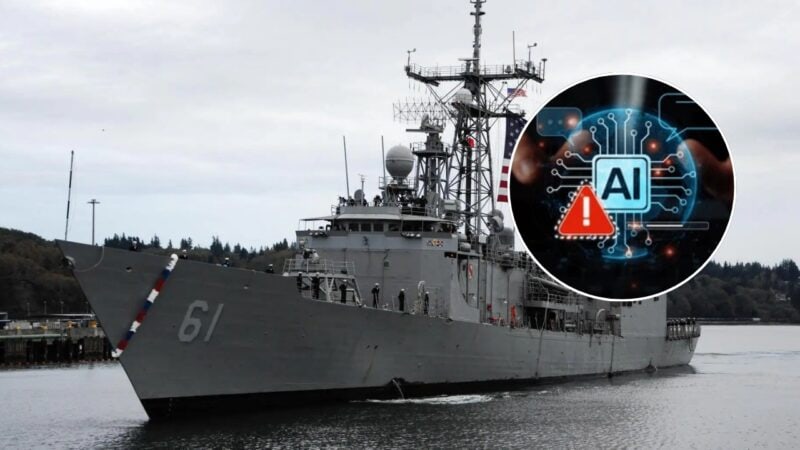
An intelligence report prepared with the help of Artificial Intelligence nearly triggered a United Stated (US) military operation against a Chinese ship during the ongoing war with Iran after an AI chatbot wrongly identified the vessel’s cargo as components linked to a nuclear weapons programme, multiple media outlets have reported citing four sources familiar with the matter.
The report, circulated across the US military, prompted plans to intercept the vessel. Two of the sources said that armed US personnel were preparing to board the ship, while military aircraft were already in the air.
Officials only stopped short of the planned operation after they examined the intelligence more closely and discovered that an analyst had used an AI chatbot to produce the report. The chatbot had incorrectly identified the material the ship was carrying.
It could not be determined what the cargo actually was.
One source described the report as “entirely false” and said that it “almost started a war”, pointing to the risk that an operation against a Chinese vessel could have escalated into an armed conflict between the US and China.
The incident began when a US Special Operations Command analyst used a chatbot to examine intelligence concerning the ship’s manifest. The original intelligence came from US Special Operations Command Pacific, which is based in Hawaii.
The chatbot combined open-source intelligence with secret signals intelligence held by the US government and reached the wrong conclusion about the ship’s cargo. The analyst then used AI a second time to package those findings into a standard intelligence report, which was distributed through military channels, according to CNN.
It remained unclear whether the chatbot was a commercially available system or a tool developed for the US government. A former senior US official familiar with the AI systems used by military and intelligence analysts told CNN that internal government tools were “mostly just copies of the commercial stuff wearing lipstick.”
The episode comes as the US military and intelligence community expand their use of AI across operations. Officials are using or exploring the technology for tasks ranging from analysing large volumes of intelligence and selecting targets for strikes to managing budgets, logistics and supply chains.
The incident also highlights concerns among analysts that AI systems could contribute to serious miscalculations when governments rely on inaccurate or corrupted data, particularly during a war.
In this case, an incorrect assessment of a Chinese ship’s cargo could have led to military action against the vessel.
The US military is accelerating AI adoption in part because officials believe the technology can help make battlefield decisions faster, including decisions over which targets to strike and where to move military assets.
Officials have also argued that the US cannot afford to fall behind in AI integration if it eventually has to fight China or another adversary that could use the technology to gain an advantage.