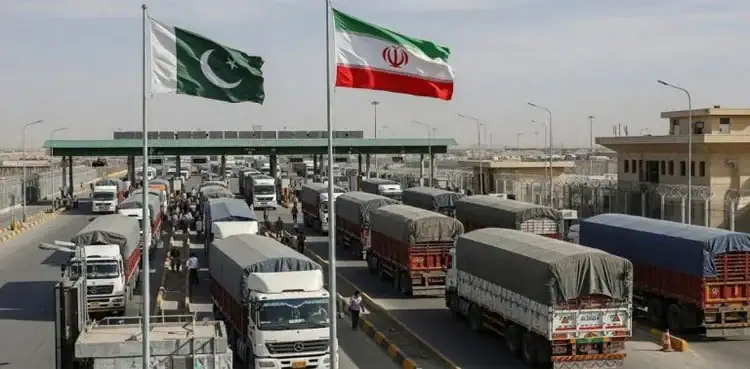
The Federal Government of Pakistan has issued the “Transit of Goods through territory of Pakistan Order 2026,” establishing a legal framework for the movement of foreign cargo to Iran through Pakistani land and sea routes.
The move activates provisions from a 2008 agreement between Pakistan and Iran on the international transport of goods and passengers.
The order, effective immediately, facilitates the transport of goods originating in third countries that are destined for Iran. Under the mechanism, “transit” refers to the movement of goods across Pakistan as part of a journey that begins and ends outside of the country’s borders.
The shift in trade logistics allows Pakistan to utilize its geography for regional connectivity while providing an alternative to traditional routes.
The formalization follows a period of significant disruption at the Pakistan-Afghanistan border, where frequent closures of key crossings like Torkham and Chaman have caused trade volumes to drop and left thousands of containers stranded. Strained relations and security concerns have led both nations to seek alternative pathways.
By operationalizing the Iran-bound routes, Islamabad is establishing a more predictable transit system that reduces its reliance on volatile northern border crossings for regional trade flow.
To manage the movement, the Ministry of Commerce has designated specific transit transport corridors. The routes link major ports such as Karachi, Port Qasim, and Gwadar to border points including Gabd and Taftan.
One designated corridor connects Karachi and Port Qasim to Taftan via Khuzdar and Dalbandin. Another route links Gwadar to the Gabd border. Further corridors pass through areas such as Turbat, Hoshab, Panjgur, Quetta, and Nokundi to reach the Iranian border.
The Federal Board of Revenue and the Customs Act of 1969 will regulate the cargo movements.
Traders are required to provide Customs Security, which the order defines as an encashable financial guarantee equivalent to the import levies of Pakistan, guaranteeing ensures compliance with national customs laws while the goods are in transit.
The order also permits Cross Stuffing, allowing the transfer of goods between containers or different modes of transportation according to custom regulations.
By formalizing the land and sea corridors, the government has established a structured mechanism for transit trade that functions independently of northern land routes.





