In the latest chapter of Donald Trump’s trade wars, the U.S. president has shocked the world with a surprising move: imposing tariffs on uninhabited islands near Antarctica and other remote territories. These donald trump tariffs penguins, which range from 10% to 50%, target places that not only have no significant trade with the U.S. but also host penguins and other wildlife instead of humans. The announcement has left the world scratching its head, and social media has been buzzing with memes about penguins and remote islands. Let’s break down everything you need to know about this strange and confusing decision.
The New Tariffs: A Bizarre List of Targets
On April 3, 2025, Donald Trump unveiled a list of territories and countries that would be hit with new tariffs, and it was anything but ordinary. While most people expect trade tariffs to target major economic players or competitors, Trump’s administration took an unexpected turn by including several remote territories, including uninhabited islands near Antarctica.
Among the most surprising additions were the Heard Island and McDonald Islands, which are part of Australia’s external territories. These islands are so isolated that they are accessible only by a lengthy two-week boat ride from Perth, Australia, and they have no human population at all. The only residents of these islands are penguins, seals, and other wildlife.
The Tariffs on Heard and McDonald Islands
The U.S. administration decided to impose a 10% tariff on all exports from Heard Island and McDonald Islands. This move is baffling because, as mentioned, these islands do not have any human inhabitants or a known trade relationship with the U.S. The only “exports” from these islands could be related to scientific research, but that’s a different area altogether.
Why target a place with no economy? The tariff announcement has left many scratching their heads. Even former communications chief for Trump, Anthony Scaramucci, joked about the absurdity of it all, humorously saying that the penguins have been “ripping off” the U.S. for years.
The Impact of the Tariff on Norfolk Island
While Heard and McDonald Islands may seem like the most bizarre case, there is another small island that also made headlines: Norfolk Island. Located 1,600 kilometers northeast of Sydney, Norfolk Island has a population of only about 2,188 people. Its main exports to the U.S. in 2023 included leather footwear, worth about US$413,000.
Despite its tiny size and minimal trade, Norfolk Island has been slapped with a 29% tariff, a full 19 percentage points higher than the donald trump tariffs penguins on the rest of Australia. Australian Prime Minister Anthony Albanese expressed his confusion about this, saying, “I’m not quite sure that Norfolk Island, concerning it, is a trade competitor with the giant economy of the United States.”
The tariffs on Norfolk Island have sparked further concerns about the fairness and logic behind Trump’s policies, especially when you consider the island’s negligible trade relations with the U.S.
Memes Take Over the Internet
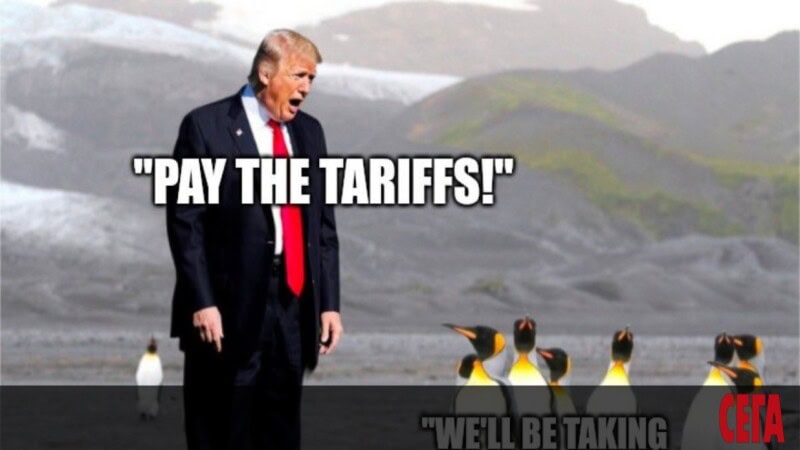
Unsurprisingly, the internet has had a field day with the latest donald trump tariffs penguins decisions. Social media is flooded with penguin memes and jokes about the situation. One viral meme humorously placed a penguin in the Oval Office instead of Ukrainian President Volodymyr Zelensky during his recent clash with Trump. Another meme showed First Lady Melania Trump gazing up at an emperor penguin, replacing Canadian Prime Minister Justin Trudeau, while Trump looked on in disbelief.
These memes reflect the global confusion and amusement surrounding the tariffs. It’s one thing to impose tariffs on large, competitive economies, but it’s another entirely to target remote, uninhabited places where the only “exports” are penguins and glaciers.
Why Did Trump Target These Remote Places?
The obvious question on everyone’s mind is: Why would Trump impose tariffs on such remote and uninhabited territories? The White House has not provided a clear answer, but some experts speculate that it could be part of a larger strategy to make a statement about U.S. economic power. By targeting places that seemingly pose no threat, Trump might be trying to assert that no one, no matter how small or remote, is exempt from his tariffs.
In the case of Norfolk Island, the U.S. may see it as an easy target because of its small economy. However, the tariffs seem more likely to confuse than to achieve any meaningful trade objectives.
Other Unexpected Targets of donald trump tariffs penguins
It’s not just remote islands that are affected by these tariffs. New donald trump tariffs penguins list also includes territories that have minimal economic activity with the U.S. One such place is Saint-Pierre-et-Miquelon, a tiny French archipelago located near Canada. The U.S. has decided to impose a whopping 50% tariff on exports from this remote region, making it one of the highest tariffs on the list.
While the French islands have only minimal trade with the U.S., the decision to target them raises eyebrows. It is especially strange considering that China, which is a much larger economic competitor, faces tariffs of only 34%.
Another area of concern is the U.S. tariffs on French overseas territories like Guadeloupe, Martinique, and French Guiana. Although these territories are part of the European Union, they face significantly different tariff rates than mainland France. For example, Réunion, another French island, is slapped with a 37% tariff, even though it has the same legal status as other French territories.
The Economic Consequences
The economic impact of these tariffs has been significant. After Trump’s tariff announcement, U.S. stocks took a major hit, marking their worst day since the COVID-19 pandemic in 2020. Experts are warning that these tariffs could lead to further market instability as investors struggle to make sense of Trump’s unpredictable trade policies.
While the tariffs on places like Heard Island and Norfolk Island might not have an immediate impact on global markets, they contribute to an overall atmosphere of uncertainty and confusion.
Global Reactions to Trump’s Tariffs
Reactions to Donald Trump’s tariffs Penguin policies have been mixed. Many world leaders have expressed frustration with the unpredictability and unfairness of the decisions. Australian Prime Minister Albanese summed it up best, saying, “Nowhere on Earth is safe.” His comments highlight the global confusion about why the U.S. is targeting some of the world’s most remote and peaceful places.
Some leaders, like Emmanuel Macron of France, have strongly criticized the tariffs, especially those targeting French overseas territories. Macron described the tariffs as “exorbitant” and unfairly punishing regions that have close economic ties to the EU.
Conclusion: A World Gone Mad?
Latest donald trump tariffs penguins have undoubtedly caused widespread confusion and laughter, but they also highlight the unpredictable nature of his trade policies. By targeting uninhabited islands, small territories, and even penguins, Trump has made it clear that no place is too small or too remote to escape his tariffs.
As the world tries to process the absurdity of the situation, one thing is clear: these tariffs are more than just a joke. They are a reminder of the challenges that come with unpredictable trade wars and the global instability that they can create. Whether or not the U.S. will stick to these tariffs remains to be seen, but for now, it’s hard to ignore the penguin memes filling up social media feeds everywhere.