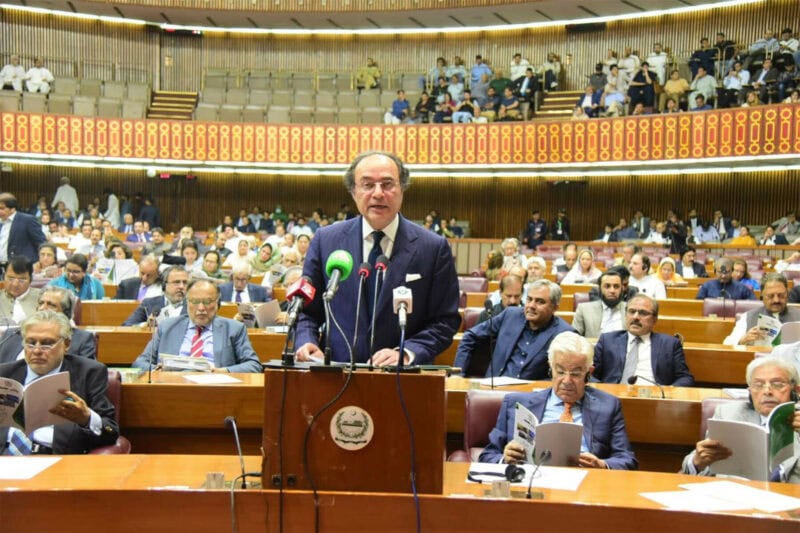
Finance Minister Muhammad Aurangzeb unveiled a Rs18.8 trillion federal budget for fiscal year 2026-27 on Friday, proposing tax relief for the salaried class, incentives for exporters and small businesses, and a three-year freeze on provincial transfers backed, for the first time, by provincial grants exceeding Rs1 trillion.
Within hours, reactions from politicians, journalists and analysts split along lines that have become familiar in Pakistan’s budget season: those who saw a government finally getting something right, and those who saw the same old story dressed in new numbers.
The praise came first, and it came with conviction.
Journalist Muneeb Farooq called the relief for the salaried class long overdue. “After years of exploitation owing to heavy tax burden, Pakistan’s salaried class finally gets some relief,” he wrote on X, adding that the absence of any new tax on salaried individuals made the budget a welcome step.
Defence minister Khawaja Asif framed it as proof of strong leadership, arguing that “While governments across the world were being forced to pile pressure on their citizens under economic strain, Pakistan had managed to deliver meaningful relief to salaried workers, industry and investors.” He credited three years of gradual economic recovery for making the budget possible.
Chief Executive Officer and Director of Maple Leaf Capital Limited Waleed Saigol struck the most measured tone of the day, urging patience over panic: “After an immensely impressive stabilisation phase, Pakistan is now transitioning towards a sustainable growth model. This is a test match not a T20 match.”
The other side was louder and considerably less forgiving.
Senior journalist Ansar Abbasi focused on a single number that he said swallowed everything else: Rs8 trillion in interest payments, equal to 43 percent of the entire national budget. “Interest is devouring Pakistan and the nation, but no one seems to have any thought of escaping this curse,” he wrote.
Former Federal Minister for Maritime Affairs Ali Haider Zaidi said that for every one rupee the government invests in roads, hospitals, schools and dams, eight rupees go straight to debt servicing. Pakistan’s entire development budget for the year stands at Rs1,000 billion. Interest payments alone come to Rs8,054 billion. “This is not a budget,” Zaidi wrote. “This is a confession.”
He added that “The debt being serviced today was not borrowed to build the country but accumulated by corrupt rulers who were simultaneously building private empires at home and abroad.”
Former PTI leader Chaudhry Fawad Hussain called the budget “a document of political accommodation dressed up as fiscal policy”. He pointed to Rs800 billion allocated to BISP which he described as an opaque programme — while Punjab’s share was reduced by Rs650 billion. He argued that “Punjab’s development projects, already largely confined to Lahore, had now been effectively eliminated.” The shortfall of Rs3,500 billion, he said, “was being papered over by terminating development projects outright”.
He questioned the logic of increasing defence expenditure while cutting education and science budgets, and noted that “neither the ministry of science nor education had produced a project or roadmap in five years.”
Salman Akram Raja went deeper into the provincial dimension, arguing that “the federal government’s decision to demand money from provinces to cover a deficit exceeding Rs1 trillion was a constitutional assault dressed up in budget language”. Health and education, he noted, are constitutionally the provinces’ responsibility and Pakistan already ranks among the lowest-spending countries on both.
Former minister Hamad Azhar warned that the real damage was not in the headlines but buried in legislative fine print. “Hiding under the obscure legislative clauses is a most complicated and oppressive tax regime,” he wrote, adding that “bloated expenditures financing multiple unnecessary public sector departments remained untouched and unexamined”.
Former finance minister Miftah Ismail offered perhaps the most clinical verdict of the day. The budget provided some relief for the salaried class and businesses, he acknowledged, but he “could not find in it any serious effort to substantially grow exports, accelerate economic growth or reduce poverty.” For a healthy economy, he said, it was fair. For a struggling economy desperately in need of jobs and growth, it was “uninspired”.
The sharpest commentary came from the floor of the National Assembly. MNA Noor Alam Khan, quoted by journalist Naureen Saleem Junjua, put it in terms that required no elaboration: “They’ve made business class tickets cheaper for themselves. If someone was buying a cheap car, they’ve made it expensive. This is the elite’s budget”.
PTI’s Asad Umar, watching the finance minister’s speech, reduced the entire address to a punchline: “Crux of the finance minister’s budget speech so far: my boss is great and his boss is even greater and Trump likes both of them a lot.”
Journalist Fahd Husain left the most fundamental question of the day unanswered, and perhaps unanswerable: “Every budget season we are told the IMF made us do it. Did they?”
Hamid Mir kept it shortest of all. “When they announce the budget, the poor get the shock of it”.