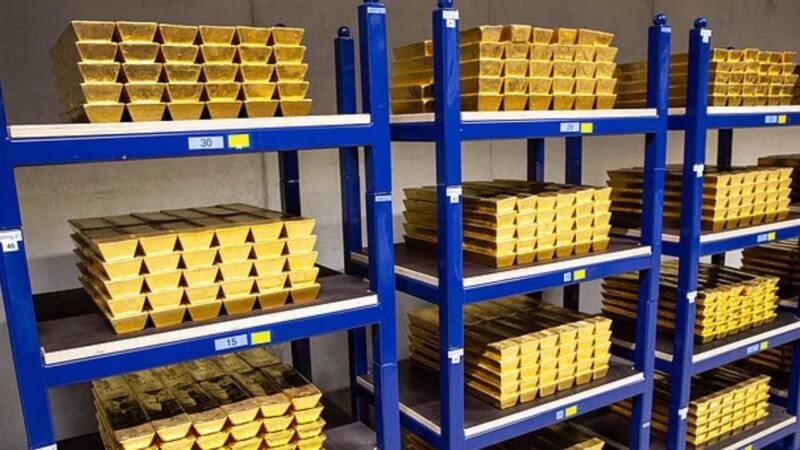
The Dutch central bank has moved 86 tonnes of its gold reserves from the United States (US) and Canada to London, citing increasing “geopolitical unrest” and the need to make its reserves more readily available in a crisis.
De Nederlandsche Bank (DNB) said that gold held in London could be traded more easily than reserves stored in New York and Ottawa. The bank stated that holding more gold in London would allow it to deploy the reserves more quickly in a crisis situation.
“With this step, we have improved the deployability of the gold reserves. We assume that we will never need to deploy the gold, but it is nevertheless necessary to strengthen our resilience and preparedness,” DNB president Olaf Sleipjen said.
DNB said that the Netherlands held 612.4 tonnes of gold worth €72.2 billion ($83.7 billion) at the end of 2025.
Before the move, 31.3 percent of the Dutch gold reserves were held in New York and 19.7 percent in Ottawa. Following the transfer, the share held in each location fell to 18.5 percent.
The share of Dutch gold stored in London increased from 18.1 percent to 32.1 percent, while 30.8 percent of the reserves remain in the Netherlands.
DNB also stated that it completed the operation through a combination of buying and selling gold and physically transferring part of its reserves.
The bank physically moved more than 27 tonnes of gold from the US and Canada to Zeist in the Netherlands. The same quantity was then moved from Zeist to London, allowing the bank to avoid melting down gold bars.
“By combining buying and selling and physical transport, the risks associated with physically moving a large quantity of gold have been spread,” DNB said.
The operation took place between March and August.
Laurent Schwartz, president of the Paris-based National Gold Counter, which facilitates gold trading in France, said that central banks had been moving their reserves between locations for about a decade.
Schwartz stated that the political situation in the US could also encourage some central banks to choose other locations for storing their reserves. He described the London market as the deepest and most liquid, making gold easier to deploy during a crisis.