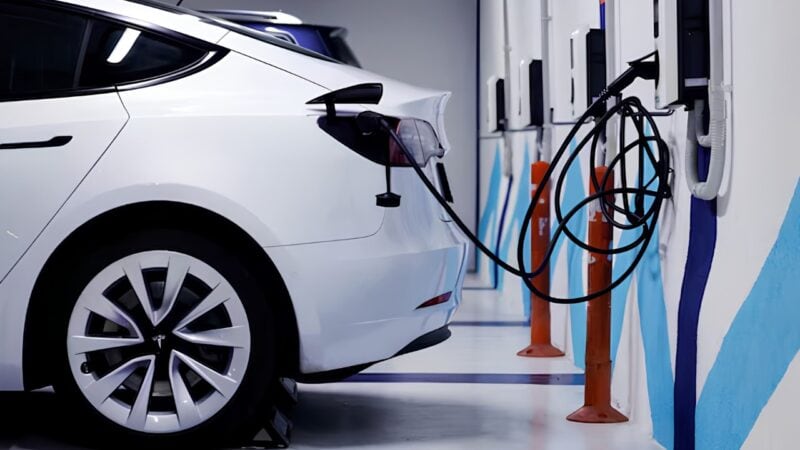
The federal government has shelved a proposed auto policy centred on accelerating the adoption of electric vehicles (EVs) and ordered a fresh draft after local carmakers raised concerns over the framework, news reports have said.
The Ministry of Industries and Production had prepared the proposed Auto Policy 2026-31 following consultations with stakeholders, with a key focus on promoting EVs to reduce Pakistan’s dependence on imported petroleum products. Pakistan imports around 80 percent of petroleum products needed to meet domestic demand.
According to reports, local automobile manufacturers approached Prime Minister Shehbaz Sharif, arguing that the proposed policy gave EVs an unfair advantage over conventional vehicles.
The prime minister then ordered the draft to be reviewed, formed a new committee and tasked Deputy Prime Minister Ishaq Dar with preparing a revised version of the policy.
Reports said that the industry’s primary concern was not the transition to electric mobility itself but the proposed incentive structure.
Manufacturers argued that Pakistan should gradually shift towards EVs while ensuring the development of local manufacturing capacity, technology transfer and domestic production of key components.
The delay in notifying the new policy has also had financial consequences for the industry. The Auto Industry Development and Export Policy 2021-26 expired on June 30, 2026, resulting in the automatic restoration of a 25 percent General Sales Tax (GST) by the Federal Board of Revenue. GST is a consumption tax imposed on goods and services.
Hybrid electric vehicles had previously benefited from a reduced GST rate of 8.5 percent. As the new policy was not implemented before the previous framework expired, the concession lapsed.
From July 1, 2026, hybrid and plug-in hybrid vehicles became subject to the standard 25 percent GST, matching the rate already applicable to conventional petrol and diesel vehicles.
According to reports, the tax increase prompted Toyota and Honda to raise prices of some hybrid models by more than Rs1.3 million, while certain manufacturers temporarily suspended invoicing and vehicle deliveries because of uncertainty over the policy.
The Pakistan Association of Automotive Parts & Accessories Manufacturers (Paapam) has called on the government to introduce a transitional tax structure, including an 18 percent GST on hybrid vehicles, until Pakistan develops an adequate EV charging network and domestic EV components industry.
Paapam said it supports the shift towards electric vehicles but believes the transition should be gradual and tied to annual localisation targets. It also proposed local production of batteries, motors and electronic components, assistance for existing parts manufacturers to upgrade their facilities, and technology transfer to Pakistani vendors.
The association warned that extensive incentives for EVs without a clear transition plan for conventional manufacturers and parts suppliers could weaken local manufacturing, jeopardise existing investments and threaten employment.





