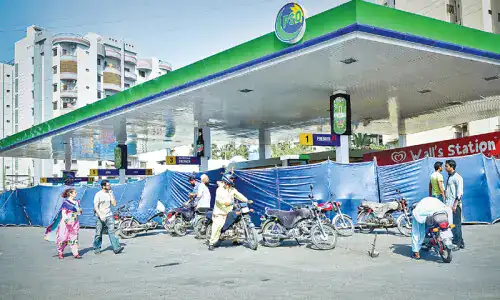
The government has increased the prices of petroleum products while facing an immediate threat of a nationwide shutdown of fuel stations.
The price of petrol has risen by Rs4.93 per litre, reaching Rs320.73 per litre. The price of High-Speed Diesel (HSD) went up by Rs7.15 per litre, bringing the rate to Rs367.21 per litre. The Petroleum Division issued a notification confirming that the revised rates take effect on July 22.
The price hike follows fluctuations in international oil markets driven by conflicts in the Middle East. Petrol prices had reached a peak of Rs458.41 on April 3 after rising from Rs266 in early March. HSD peaked at Rs520.35 on April 3 after beginning an upward rise from Rs281 following the outbreak of the US-Iran war on February 28.
Petroleum Minister Ali Pervaiz Malik announced that the cabinet and the prime minister authorized the Oil and Gas Regulatory Authority (OGRA) to shift to a daily pricing mechanism based on international market trends.
The government had previously moved to weekly revisions in March to manage supply concerns arising from Middle East tensions and the Strait of Hormuz situation.
The decision to revise prices on a daily basis led to a breakdown in negotiations between the government and fuel station operators. The All Pakistan Petrol Pumps Owners Association (APPPOA) announced a nationwide strike starting Wednesday midnight which will leave approximately 15,000 fuel stations closed on Thursday.
APPPOA Vice Chairman Nauman Ali Butt stated to the press that the daily price revision plan was “unacceptable to petrol pump dealers and unworkable.” Butt added that the association’s core demands include setting prices on a monthly basis and increasing dealer commissions, which have remained unchanged for three years.
APPPOA Chairman Humayun Khan stated that station owners operate on thin margins and face severe pressure from regulators, oil marketing companies, and policy shifts.
Khan noted that the daily system “created confusion and destroyed our businesses,” adding that oil marketing companies could manipulate fuel deliveries during price drops. Khan called the lack of prior consultation “ironic” and requested the government reconsider the decision, adjust commissions, and involve owners in policy decisions.
A separate body, the Pakistan Petroleum Dealers Association (PPDA), met with the petroleum minister and OGRA officials. PPDA Senior Adviser Malik Khuda Bukhsh called the daily pricing system “not possible and unacceptable.”
Khuda Bukhsh stated that OGRA representatives acknowledged the decision was taken in haste, requested seven days to brief the government, and asked for patience. The PPDA executive committee will meet on Wednesday to vote on joining the strike.
The Petroleum Division issued a statement claiming that talks with the PPDA were successful, asserting that the delegation appreciated supply management during the regional crisis and “assured the minister of the association’s full support for the government’s policy.”
Malik explained to the delegation that daily pricing uses a seven-day rolling average to reflect international price shifts, reduce market distortions, and improve transparency.
Monthly sales for petrol and HSD range between 700,000 and 800,000 tonnes, compared to 10,000 tonnes for kerosene.
Petrol price shifts impact lower- and middle-income segments using two-wheelers, rickshaws, and small vehicles, while diesel price changes affect the public through heavy transport, generators, and power generation costs.





