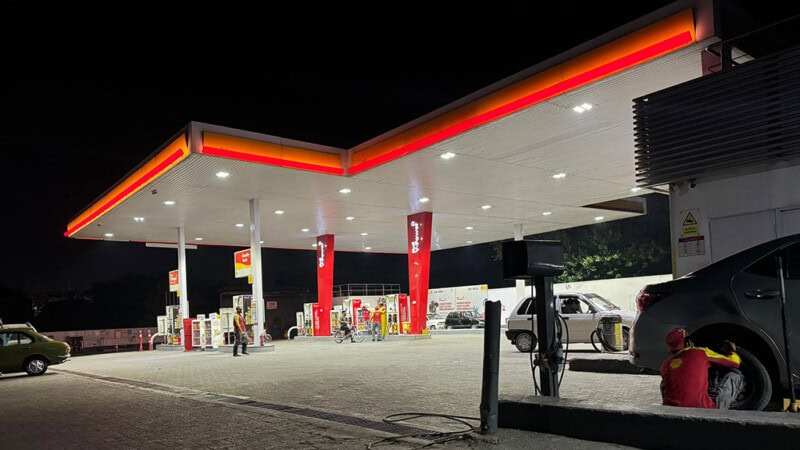
The federal government has increased the price of petrol by Rs5.02 per litre and High-Speed Diesel (HSD) by Rs5.28 per litre, with the new rates taking effect from Saturday.
Petrol will now cost Rs375.82 per litre, while HSD will be sold at Rs403.32 per litre, according to a Petroleum Division notification. The government continues to charge Rs114 per litre in taxes and duties on petrol and Rs100 per litre on diesel.
The revised prices will remain in effect from Sept 12 to Sept 14.
The increase comes as oil prices remain above $100 a barrel despite a decline on Friday. Brent crude futures fell $2.46, or 2.29 percent, to $105.17 a barrel, while US West Texas Intermediate (WTI) crude dropped $2.44, or 2.38 percent, to $100.04 a barrel.
Pakistan has revised fuel prices several times following movements in international oil markets. HSD had reached Rs520.35 per litre on April 3 after rising from Rs281 per litre when the United States (US)-Iran war began on February 28.
Petrol had also reached a peak of Rs458.41 per litre on April 3 after starting to rise from Rs266 in the first week of March.
The government had been announcing weekly fuel price revisions since early March, along with fuel conservation measures over possible disruptions to oil supplies during the conflict in the Middle East.
On July 17, Petroleum Minister Ali Pervaiz Malik announced that the government would move to daily fuel price adjustments because of fluctuations in international market prices following renewed hostilities between Iran and the US.
The federal government had also announced targeted relief measures in April to provide subsidised fuel.
Petrol is mainly used in private transport, small vehicles, rickshaws and two-wheelers, making changes in its price relevant to middle and lower-middle-class consumers.
HSD is mainly used in heavy transport, power plants and large generators, meaning changes in its price also affect the public.
Petrol and HSD remain the main revenue earners among petroleum products, with monthly sales ranging between 700,000 and 800,000 tonnes. By comparison, monthly kerosene demand stands at around 10,000 tonnes.





