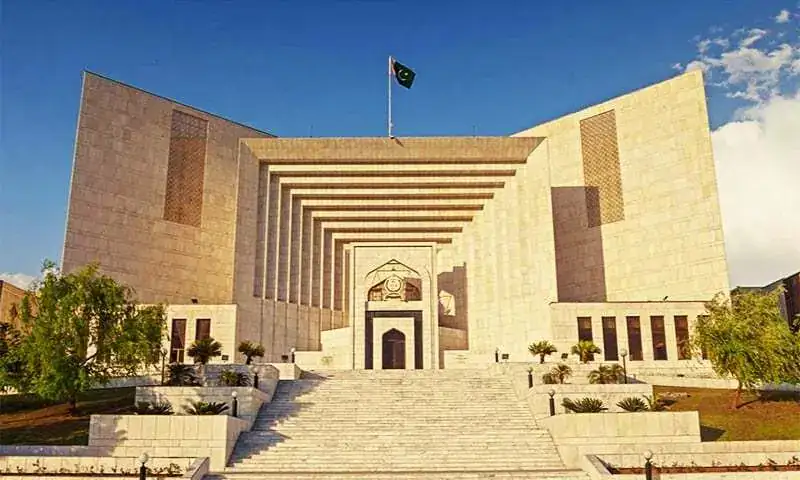
The Supreme Court (SC) has ruled that dower (Mahr) is a mandatory part of a marriage under Islamic law and must be paid by a husband to his wife in good faith, at the agreed time and without conditions that undermine her dignity.
A four-member bench headed by Justice Shahid Waheed and comprising Justice Irfan Saadat Khan, Justice Aqeel Ahmed Abbasi and Justice Shahid Bilal Hassan issued the unanimous ruling while hearing a batch of civil and criminal petitions concerning the legal effect of conditions recorded in Nikahnamas regarding dower.
The court said that if a husband fails to pay dower, courts must intervene “not with hesitation, not with apology, but with full authority of the law.”
In the 26-page judgement authored by Justice Waheed, the court held that dower is neither the “price of the wife” nor consideration in the technical common-law sense. Instead, it forms the wife’s exclusive proprietary right.
Justice Waheed said that the right to dower reflects constitutional values of human dignity, equality before the law, protection of the family and adherence to Islamic injunctions.
The judgement directed courts dealing with dower disputes to interpret the relevant laws in a way that gives practical and effective protection to a wife’s lawful entitlement while remaining faithful to the agreement established through evidence.
The court stated that marriage must not become a transaction where a wife’s rights become an afterthought, while a husband cannot use dower as a weapon during later disputes.
Justice Waheed also explained that conditions linking the payment of dower to a wife’s behaviour or decision to seek divorce do not qualify as dower. “I will pay you if you behave; I will pay you if you do not ask for divorce. That is not dower,” he observed, adding that such a condition amounts to coercion.
The judgement added that courts must approach dower cases with the understanding that a wife’s dignity is at stake. It described her right to dower as not a favour but a command of Sharia, statute and justice. Courts must determine the extent of that right from the evidence and ensure its fulfilment.
The court also referred to the Sunnah of the Holy Prophet (peace be upon him), stating that he did not treat dower as a ceremonial formality.
The judgement stated that he insisted that every marriage contract include dower according to the husband’s means, encouraged moderation in its amount, condemned extravagance and recognised the wife’s proprietary entitlement.
In his additional note, Justice Shahid Bilal Hassan issued directions for strict compliance with the Muslim Family Laws Ordinance, 1961 and the relevant rules, with particular emphasis on accurately recording the terms of Nikahnamas.
The court directed Nikah registrars to complete all relevant columns of the Nikahnama carefully and not leave any column blank or treat it as unnecessary without lawful justification.
It specifically ordered care in recording dower in Columns 13 to 16. Column 13 must clearly state the total dower agreed between the parties, whether it consists of money, movable property or immovable property.
Where property forms part of the dower, Column 16 must include enough details to identify it, including its description, measurements, location and value where the parties have agreed on one.
Nikah registrars must also read out or explain the relevant entries to the parties before obtaining their signatures or thumb prints, particularly when the Nikahnama includes terms concerning dower, special conditions, delegated right of talaq or property given as dower.
The court directed that any special condition entered in Column 17 must accurately reflect the agreement between the parties. Registrars must not add terms themselves or make entries based on assumptions. If the agreement is unclear, they must seek clarification from the parties.
After execution, the Nikahnama must be properly authenticated and preserved, copies must be provided to both spouses and the required copy must be forwarded to the concerned union council.
The court also directed competent authorities, particularly union council chairmen and secretaries, to ensure that licensed Nikah registrars understand the statutory purpose and proper completion of each column, particularly Columns 13 to 16.
Periodic training and orientation must be arranged, while competent authorities should periodically inspect registers to ensure compliance with the law, rules and licence conditions.
Where a Nikah registrar fails to perform statutory duties or violates licence conditions, the competent authority should take action in accordance with law, the court ruled.