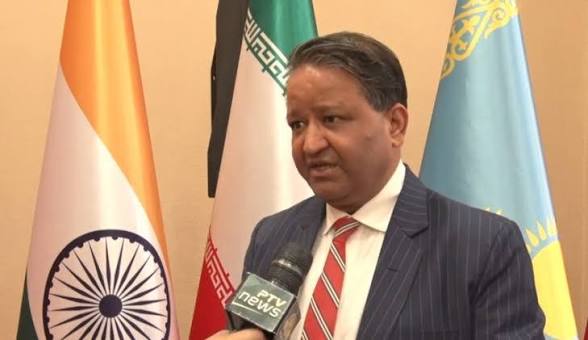
India’s National Coordinator for the Shanghai Cooperation Organization (SCO), Alok Dimri, arrived in Pakistan this week for meetings under Islamabad’s presidency of the regional bloc, marking a rare diplomatic engagement between the two countries amid strained bilateral ties.
Dimri said on Wednesday that his visit was part of the SCO’s activities during Pakistan’s chairmanship, which will continue throughout the year and culminate in the group’s summit in Islamabad in 2027.
“For me, this is the first opportunity to come to Pakistani soil, and through the SCO, these programs will continue throughout the year and will culminate with the Islamabad Summit,” Dimri told reporters in Islamabad.
He described the visit as part of the SCO’s annual rotation and said that India expected progress in the organisation’s areas of cooperation.
“So, this is an annual rotational ritual of the SCO in which we are participating, and our expectations are that there will be new progress in all the ongoing cooperation verticals of the SCO and that we will move forward,” he said.
The visit comes more than a year after India and Pakistan fought a four-day military conflict involving artillery, fighter jets, missiles and drones. The two countries have also maintained downgraded diplomatic relations over Illegally Occupied Jammu and Kashmir, with neither country currently having an ambassador in the other’s capital. Their diplomatic missions are headed by a Charge d’Affaires.
Against that backdrop, official engagement between Islamabad and New Delhi has remained limited in recent years, with multilateral forums such as the SCO providing a platform for interaction.
Dimri said that the organisation allowed member states to work on regional connectivity, trade and transit. He described the SCO as a platform bringing countries across the Eurasian and Asian landmass together around shared areas of cooperation.
“Connectivity is very important in this, regional connectivity, trade and transit. These are some of the important issues that have been discussed, and progress is being made going forward,” he said.
The SCO was founded in 2001 by China, Russia, Kazakhstan, Kyrgyzstan, Tajikistan and Uzbekistan. India and Pakistan became full members in 2017, followed by Iran in 2023 and Belarus in 2024.
Dimri also added that English could potentially be introduced as a working language for SCO discussions during Pakistan’s presidency. The organisation’s discussions have so far taken place in Russian and Chinese.
“So far, discussions among our member states in the SCO have taken place in Russian and Chinese. Now, perhaps, English may also be introduced under the Pakistani presidency,” he said, calling it an “important” occasion for the organisation.
He also spoke about cultural cooperation and said that he hoped to visit more Pakistani cities during future SCO meetings. Dimri stated that he had so far visited only Islamabad but mentioned Lahore, Sialkot and Faisalabad among the places he wanted to see.
“There will be activities throughout the year, so we hope that through these activities, we will get the opportunity to see more of Pakistan and also meet more people,” he said.
Pakistan took over the SCO chairmanship for 2026-27 at a leaders’ summit in Bishkek earlier this month and will oversee the organisation’s programme until it hosts the next Council of Heads of State summit in Islamabad next year.
During their Sept. 28-30 meeting, SCO national coordinators reviewed progress on key initiatives and discussed coordination among member states and implementation of Pakistan’s chairmanship priorities under the theme, “Turning Vision into Action: Connectivity, Innovation and Shared Prosperity.”
The delegates also visited the Pakistan National Council of the Arts, where they were briefed on the country’s cultural heritage and artistic traditions, and the Naseer Bunda Hockey Stadium, where they received a briefing on arrangements for the SCO Hockey Tournament scheduled from November 20 to December 2.
The national coordinators also met Foreign Minister (FM) Ishaq Dar, who highlighted Pakistan’s priorities for its SCO chairmanship and its commitment to working with member states on the organisation’s objectives.
“The meeting concluded with agreed outcomes. The participating National Coordinators reaffirmed their commitment to SCO goals and to advancing the objectives of the Organization through continued engagement and practical cooperation,” Pakistan’s foreign ministry said.