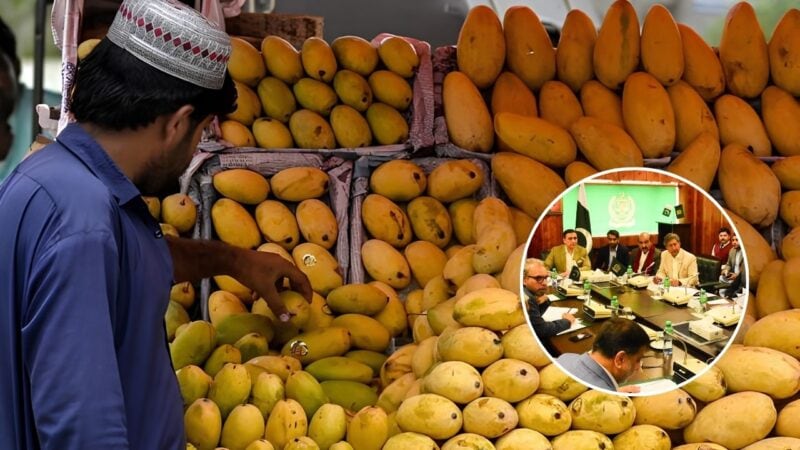
A parliamentary committee has expressed deep concern over a sharp decline in Pakistan’s mango production, linking the crisis directly to the growing use of artificial sweeteners and chemical additives in commercial beverages.
The National Assembly Standing Committee on National Food Security and Research warned that recent regulatory shifts have severely crippled the demand for natural fruit pulp, dealing a heavy financial blow to local farmers.
During a meeting chaired by Syed Tariq Hussain, representatives from the Multan Mango Growers Association briefed lawmakers on the industry’s decline, revealing that national mango production has plunge from 2.2 million tonnes to 1.8 million tonnes in recent years.
Industry representatives explained that prior to 2021, natural mango pulp was a staple ingredient in domestic juice manufacturing. However, subsequent regulatory changes introduced by the Pakistan Standards and Quality Control Authority (PSQCA) permitted beverage companies to substitute real fruit with cheaper synthetic additives and chemical sweeteners, causing corporate demand for actual mangoes to crash.
The shift from agricultural produce to industrial chemistry has also triggered major health warnings. The Ministry of National Health Services presented findings from the National Institute of Health (NIH) alongside guidelines from the World Health Organization (WHO), pointing out the adverse health risks linked to consuming synthetic drinks, particularly for children.
In response, the committee directed health officials to coordinate with the PSQCA to revise sweetener standards and recommended doubling the mandatory minimum mango pulp content in juices from 5 percent to 10 percent. They also proposed health labels warning against serving sweetener-laden drinks to children under 14.
Beyond synthetic additives, the committee addressed export challenges, noting that arbitrary trade restrictions prior to June 1 caused severe losses for early-harvest farmers in Sindh. To protect the sector, the committee urged stricter crackdowns on hazardous ripening chemicals and instructed the commerce and foreign ministries to aggressively pursue new agricultural export avenues in China, Japan, the European Union, and the United Kingdom.