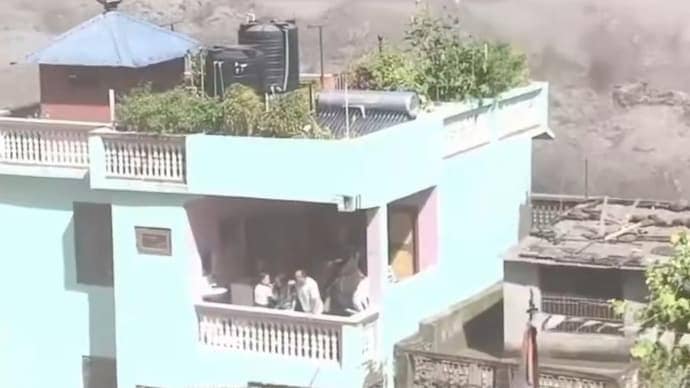
A video showing a mint-green house standing intact in Nuwakot, Nepal, during last week’s apocalyptic floods went viral across social media platforms. The flood, which ravaged mountainous towns and villages in Bagmati Province, carried mud, uprooted trees, rocks, and wreckage through the valley, destroying multiple nearby structures.
Footage shows at least three family members standing on the balcony of the house as water surrounded the property, destroying every other building in the vicinity, however, the structure withstood the torrent long enough for rescuers to reach the occupants safely.
Social media users shared various reactions and theories to solve the mystery of how the property survived the deluge. One user commented, “The House in Green which survived against all Odds.” Another user posted, “Even the brutal wrath of Nature which destroyed everything in its path couldn’t shake it’s foundation.”
Other posts claimed that the property belonged to a Christian pastor and framed its survival as divine protection. Some posts also asserted that it was the only building left standing in the area. A fact-check report addressed the claims, stating that no official reports or verified news accounts identify the owner or occupants as a pastor.
An engineering analysis by Architecture Presentation, cited by an Indian media platform, attributed the building’s survival to the materials used in construction and physical positioning. Unlike traditional stone-masonry houses common in Himalayan valleys, the green house features a reinforced-concrete frame.
According to the analysis, standard masonry structures often fail under lateral forces created by fast-moving water and debris. The analysis stated, “Continuous steel rebar tied the columns, beams, and foundation together into a single, rigid skeleton.”
The design allowed the frame to absorb lateral forces and transfer the load to the foundation, enabling the structure to function as a unified system.
The analysis also highlighted the building’s location. The house stood on elevated ground away from the main debris channel, where the heaviest rocks and material flowed. Its compact shape allowed the water to divide around both sides of the structure.
Additionally, mud and debris that accumulated around the base formed a barrier that helped redirect subsequent water surges away from the main walls, analysts have theorised.
The flooding in Bagmati Province forms part of a larger natural disaster affecting communities across Nepal and Tibet, where search operations continue for missing individuals.