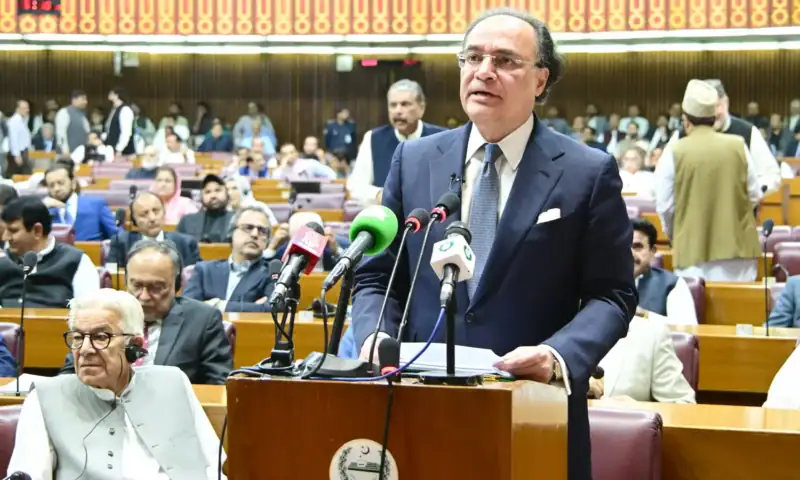
The National Assembly (NA) on Tuesday passed the federal budget for the upcoming fiscal year, starting July 1, 2026, by approving the financial bill presented in the Lower House earlier this month.
Finance Minister Muhammad Aurangzeb had moved the motion for the budget, which sets a total outlay of Rs18,771 billion. The session was chaired by Speaker Sardar Ayaz Sadiq, where the majority vote rejected all amendments brought forward by opposition members, including Aliya Kamran, Naeema Kishwar and Shahida Akhtar Ali.
Lawmaker Ali Qasim Gilani withdrew his proposed amendment prior to the voting process.
The approved financial plan targets an economic growth rate of 4 percent and sets an inflation target of 8.2 percent for the next financial year.
Revenue collection targets for the Federal Board of Revenue (FBR) are fixed at Rs15,264 billion rupees, alongside a non-tax revenue target of Rs5,336 billion.
For development and social safety nets, the government allocated Rs1,000 billion for the federal Public Sector Development Programme (PSDP) and Rs838 billion for the Benazir Income Support Programme.
Transport and communications, water resources, and energy sectors receive over 60 percent of the total PSDP allocation, while the remaining funds are divided among higher education, agriculture, health and information technology.
Lawmakers made several structural changes to the bill during the clause-by-clause approval, which included removing Clause 3 regarding the Petroleum Levy and Climate Support Levy.
An amendment to the Customs Act was incorporated to grant affected parties the right to present their position before asset confiscation. Additionally, chartered accountants can now serve as non-voting members in customs and tax cases, as well as join tax dispute resolution committees when required.
A new sales tax collection mechanism for the steel sector will operate based on electricity consumption per unit.
Businesses linked to the digital invoicing system will receive specific incentives, while digitally integrated and Point-of-Sale (POS) linked footwear businesses received tax relief measures.
The budget extends sales tax exemptions on imports of aircraft and spare parts to airlines other than Pakistan International Airlines (PIA).
While certain exemptions are scheduled to take effect from July 1, 2027, businesses generating an annual turnover of up to Rs200 million can opt out of the final tax regime, and the state will recognise business losses caused by economic difficulties when evaluating economic viability.
The bill also introduces a five percent withholding tax on income generated through social media platforms, making taxes deducted from social media payments to non-residents adjustable.
It also increases surcharges on non-filers and authorises the State Bank of Pakistan (SBP) to build a central virtual repository for banking data.
For the automotive sector, the budget maintains a zero percent federal excise duty on imported electric vehicles valued up to $75,000.
It implements a 30 percent duty on electric vehicles priced between $75,000 and $110,000, and a 40 percent duty on those exceeding $110,000. Imported vehicles with engine capacities between 2,000cc and 3,000cc face a fixed federal excise duty of 86 percent, rising to 92 percent for vehicles exceeding 3,000cc.
Taxes on imported mobile phones can now be paid in instalments whereas distributors in the pharmaceutical, fertiliser, sugar and electronics sectors see their minimum tax rate reduced to 0.5 percent.
Private equity and venture capital funds receive tax concessions under specific conditions, and exporters whose total turnover consists of more than 80 percent exports are exempted from the application of Super Tax Clause C-4.
Registered taxpayers retain the right to object to a nominated auditor within 15 days of nomination. Under the Federal Excise Act, legal proceedings now require proof of deliberate intent during violations.