The death toll from floods and landslides in Nepal has risen to 469, while hundreds of people remain missing as authorities continue search, rescue and evacuation operations across the worst-affected areas.
Three people have also died in China’s southwestern Xizang Autonomous Region, also known as Tibet, bringing the combined reported death toll in Nepal and Tibet to 472.
Figures published by a local Nepali newspaper showed that 667 people, including foreign nationals, were reported missing in Nepal by late Thursday. Chinese authorities said that more than 550 people, including 260 foreign nationals, remained unaccounted for in Tibet.
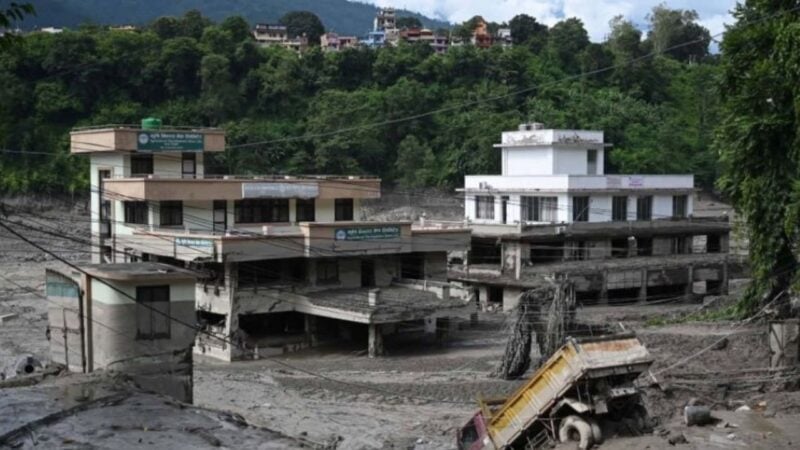
The floods and landslides struck northern and central Nepal early on Wednesday, affecting communities along the Bhotekoshi and Trishuli rivers. Floodwaters swept away homes, bridges, roads and other infrastructure, while people and debris were carried downstream.
The destruction has left several communities and travellers cut off, complicating efforts to reach affected areas. Damage to roads and transport links has also hindered rescue operations.
Nepal’s army, police and armed police force have been deployed for search, rescue and evacuation missions. Helicopters are being used to reach isolated locations and evacuate survivors, while ground teams are searching riverbanks and settlements downstream.
Nepal Tourism Board has stated that it is still verifying the whereabouts of tourists and other travellers who were in, or travelling through, Rasuwa, Nuwakot and Dhading when the floods hit.
Authorities are continuing to reconcile casualty and missing-person figures from different areas, leaving the overall scale of the disaster uncertain.
Nepal and China have also warned of further flooding risks after debris dams formed two barrier lakes on opposite sides of their border. A barrier lake is a body of water created when debris blocks a river or drainage channel; its collapse can cause sudden flooding downstream.
China has deployed an eight-member engineering team to conduct aerial surveys and three-dimensional modelling of the barrier lake, according to state broadcaster CCTV.