Tehran has announced that it will no longer honor its temporary Memorandum of Understanding (MoU) with the United States (US) unless it receives direct benefits.
Iran’s top negotiator and parliament speaker Mohammad Bagher Ghalibaf stated that if his country does not benefit from the MoU, “we have no reason to adhere to such an understanding.”
However, Ghalibaf said that Iran was still balancing diplomacy with military action in pursuit of its national interest. While Iran has “never welcomed war… we must always be prepared for battle and stand firm to protect our national security and interests”, Ghalibaf said. “We must also use the tools of diplomacy and negotiation to achieve and solidify our national interests.”
Ghalibaf emphasized that national security relies on “preserving the ‘Iranian arrangements’ over the Strait of Hormuz and ensuring the maximum safe and harmless passage of commercial ships through this waterway.”
He added, “America, which is legally empty-handed, wants to diminish the Iranian arrangements in the Strait of Hormuz by force, but we must stand firm so that the rights of the nation are realised.”
Vowing a definitive response to US actions, Ghalibaf said, “We have pledged our jugular vein for the defence of this homeland.”
“We have achieved great honours in a complex war with the greatest material power in the world, and our thinking and action must be equally great, complex, and resilient,” he added.
Iran’s foreign ministry spokesperson Esmail Baqaei confirmed that there are no plans for talks with the US, stating that Iran abandoned its commitments after Washington DC failed to uphold its side of the temporary agreement.
This diplomatic standoff comes along with a wave of US military strikes directed by US President Donald Trump. US Central Command (CENTCOM) stated that its forces struck Iranian command centers, air defense sites, missile and drone capabilities, and coastal surveillance facilities, including targets in Bandar Abbas.
Iran’s health ministry spokesperson reported that at least 35 people have been killed and 300 wounded in the US attacks this month.
Meanwhile, when asked about a deadline for the strikes, Trump stated that Iran “better behave.”
Defending the military action, US Vice President JD Vance stated: “What the President has done very, very capably is said we’re going to use military force in this situation when it’s connected to something we’re trying to achieve… But we’re not just going to do something open-ended, indefinitely… We’re going to try to use our military force as one of the many tools that we have to solve the problem.”
Following the US strikes, air defenses were activated in Tehran and explosions were heard, while Iran reported shooting down a US kamikaze drone in Bandar Abbas.
Iran’s Revolutionary Guards (IRGC) and army launched retaliatory strikes. The IRGC claimed it targeted a US air base in Jordan with ballistic missiles because US forces “used air bases located in Jordan to target various parts of Iran, including the vicinity of a children’s cancer hospital.”
Iran’s state television IRIB reported that the army also launched drone attacks on US military facilities in Jordan.
Further drone and missile attacks targeted US military facilities at Sheikh Isa Air Base in Bahrain and Ali Al Salem Air Base in Kuwait, specifically targeting radar systems, a Patriot air defense system, and fuel storage facilities.
The IRGC claimed that the Kuwait attack targeted a C-RAM early-warning radar and a gathering point for US soldiers during its “Nasr 2” operation, and called on Kuwaitis to demand the removal of US forces.
Kuwait’s army stated on X that its forces were “engaging hostile drone attacks following the nefarious Iranian aggression,” while air raid sirens sounded in Bahrain. In northern Iraq, air defenses intercepted three drones near the US consulate in Erbil.
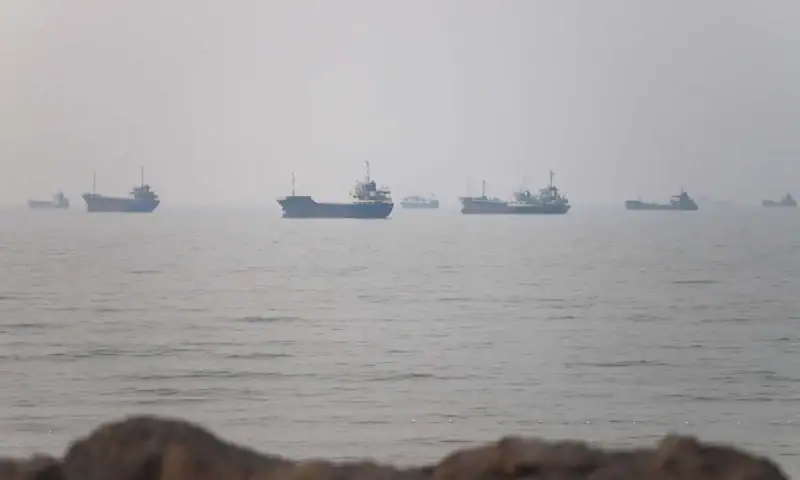
The military escalation has disrupted trade. Shipping data showed only seven vessels crossed the Strait of Hormuz on Wednesday down from 13 the previous day following a US naval blockade on Iranian ports.
Kpler data showed four empty vessels entered the Gulf, while three vessels carrying liquefied petroleum gas, coal, and fuel oil exited.
Consequently, Brent crude futures rose 0.4 percent to $85.28 a barrel, while US West Texas Intermediate futures rose 0.5 percent to $80.02 a barrel.
The US Treasury Department issued sanctions targeting individuals and entities in Iran, Russia, and Nigeria to disrupt Iran’s weapon procurement network. Additionally, the US State Department approved an estimated $1.96 billion weapons sale to Saudi Arabia to upgrade its air defenses.