France faced its worst rioting in years after protests over education and the cost of living escalated into violence across the country, leaving at least two people dead, more than 2,000 arrested and buildings and shops damaged, while similar demonstrations spread to other European countries.
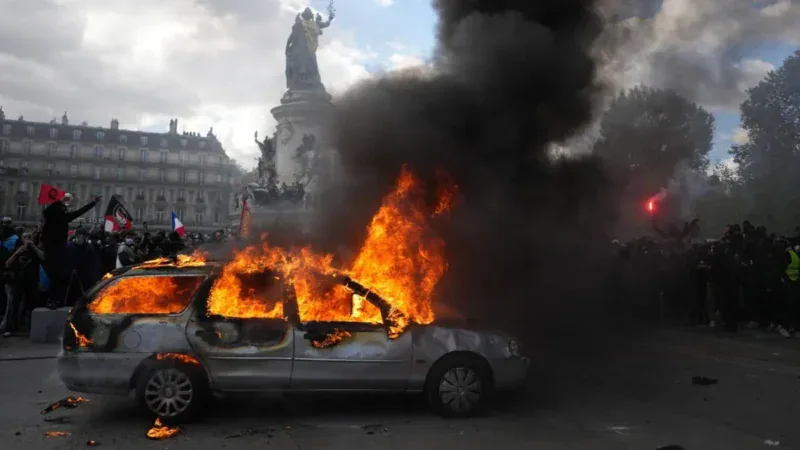
Police fired tear gas and clashed with masked rioters who set fires, looted shops and broke into government buildings over the weekend. The violence also left several people seriously injured, including two who lost their hands, while images showed historic buildings engulfed in flames.
More than 500,000 people took to the streets across France on Saturday, although authorities and political leaders stressed that most demonstrators remained peaceful. The scale of the destruction has prompted criticism of the government over its handling of the unrest, with an election to choose President of France Emmanuel Macron’s successor scheduled for next spring.
In a televised address on Sunday, Macron condemned those responsible for the destruction and promised accountability.
“Those who destroyed must pay,” he said. “Those who looted must pay back. Those who sought to bring down the Republic will be held accountable.”
Macron also announced meetings this week to discuss proposals and hear protesters’ demands, but the government faces pressure to address the grievances behind the demonstrations.
The unrest began in September when students and teachers at a high school in the Paris suburbs went on strike, demanding more staff and resources. Authorities met their demands, bringing the strike to an end, but the action triggered protests at other educational institutions.
Students across France took to the streets over understaffing and overcrowding in the education system. A forceful police response further fuelled anger, particularly after videos circulated showing an officer using a banned headlock on a girl.
The demonstrations soon expanded beyond education, drawing people frustrated with the cost of living, unemployment, the wealth divide and what they viewed as government inaction.
Maria Pallas, a 57-year-old member of a French trade union, told an international media outlet at a protest in Paris on Saturday that economic pressures had left many young people without opportunities.
“There’s the cost of living. There’s unemployment. There’s a bunch of things,” she said, adding that young people often received promises of work but ended up with nothing.
Violence intensified in several cities on Saturday night. In Paris, masked groups looted shops and started fires, while protesters set fire to Lyon’s tourist office. In Limoges, flames caused the spire of the town hall, which is 143-years-old, to collapse.
Police fired tear gas on Sunday as smaller groups continued demonstrating at Place de la République in Paris.
Residents expressed anger over the destruction, while others said that the government needed to address protesters’ concerns.
Macron also stated that he planned to take international initiatives to address fuel prices and secure stable supplies from Gulf nations, but he did not provide specific measures.
Demonstrations also took place elsewhere in Europe. Belgian students protested over the state of education, while tens of thousands marched in Lisbon, Portugal, on Saturday over living costs and the housing crisis.
In Milan, Italy, protesters clashed with police for two consecutive nights, throwing stones and looting supermarkets. Police responded with tear gas and water cannons.
In Albania, where students have protested against perceived government corruption for months, demonstrations in Tirana turned violent over the weekend, with one person photographed throwing a Molotov cocktail at riot police.
Authorities across the countries condemned the violence and called for calm.
The unrest also drew responses from US leaders. United States (US) Vice President JD Vance shared a video of the burning Limoges town hall on X and blamed the protests on failed immigration policy.
President of US Donald Trump referred to the demonstrations during a rally in Georgia, saying: “Let’s go to France and join the revolution and spend our $5,000 there,” referring to a dividend he said Republicans will provide if they win the midterm elections.