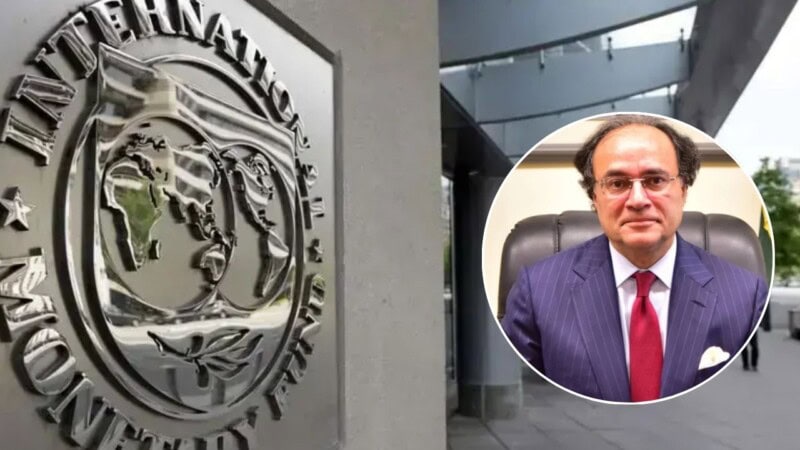
Finance Minister (FM) Muhammad Aurangzeb has said that Pakistan’s main priority remains securing early approval of the next International Monetary Fund (IMF) tranche, adding that the reopening of the Strait of Hormuz has reduced immediate pressure on the country’s economy.
Speaking to a private media outlet on Friday after a news conference at the Pakistan Embassy, Aurangzeb said that he had discussed with IMF officials the possible economic impact of the Iran conflict, but stressed that Islamabad was focused on moving forward with the next review under the ongoing IMF programme.
“Our focus is on the next tranche and on getting an early approval of the IMF board,” he said.
He said that the reopening of the Strait of Hormuz was a positive development for Pakistan and the wider global economy, as it would help stabilise oil supplies and ease pressure on international fuel prices.
“It is a very good development,” he said, adding that lower oil prices would directly benefit Pakistan, which relies heavily on imported energy.
Aurangzeb said that if the regional conflict had continued, it could have affected inflation, imports and overall economic growth.
“Had the conflict persisted, it would have adversely affected everything from economic growth to inflation,” he said.
“We hope the situation will improve, but hope is not a strategy, and that’s why we had planned for everything”.
The minister said that he also raised the issue with IMF officials, noting that the lender has support mechanisms for countries facing global economic shocks, but clarified that Pakistan was not seeking emergency relief and remained focused on the next programme installment.
He said that an IMF team is expected to visit Pakistan next month for consultations linked to the upcoming review.
During his briefing at the embassy, Aurangzeb also shared details of his meetings held on the sidelines of the World Bank-IMF Spring Meetings 2026, which were attended by State Bank Governor Jameel Ahmad and Pakistan’s ambassador to the United States (US).
He said that discussions with officials from China, the United States, the United Kingdom (UK) and other partner countries focused on expanding cooperation in trade, investment and sectors including information technology, minerals and energy.
Highlighting recent economic indicators, the minister said that Pakistan recorded a current account surplus of more than $1 billion in March, while remittance inflows reached $3.8 billion during the same month.
He added that inflows under the Roshan Digital Account stood at a record $261 million, with expectations of further growth in the coming months.
Aurangzeb said that overseas Pakistanis were continuing to play an important role in supporting the country’s external sector through formal financial channels.
He said that the finance ministry was leading tax policy discussions with the aim of expanding the tax net and incorporating feedback from stakeholders before the final proposals are sent to the cabinet and parliament.
The minister also said that improving ease of doing business remained a key priority, particularly through reducing administrative hurdles and outdated regulations.
Speaking on energy policy, he stressed that the need to move towards renewable energy while addressing long-standing structural issues in the power sector.
He stated that the recent climate-related shocks had also highlighted the need for stronger fiscal planning and better preparedness.
Aurangzeb pointed out that the government remained committed to responsible borrowing and timely repayment of financial obligations, adding that international financial forums should be used for knowledge-sharing and policy coordination rather than debt relief campaigns.





