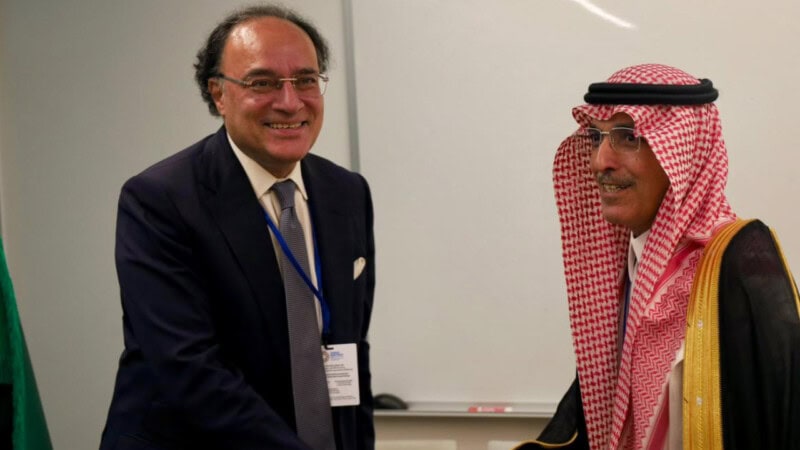
Finance Minister (FM) Muhammad Aurangzeb has confirmed that Saudi Arabia will give a fresh financial support package during his visit to Washington DC for the World Bank-IMF Spring Meetings 2026.
The Kingdom has committed a new $3 billion deposit for Pakistan while extending an existing $5 billion facility for three years. This extension moves away from previous annual rollover arrangements, providing a longer-term commitment through 2028.
The announcement comes as Pakistan prepares to return a $3.5 billion loan to the United Arab Emirates (UAE) this month. The repayment is expected to impact national reserves and could influence targets set under the International Monetary Fund (IMF) programme.
Aurangzeb stated that support from Saudi Arabia arrives at a “critical time” for the country and will “reinforce foreign exchange reserves and strengthen the country’s external account”.
The government aims to build reserves to $18 billion by the end of the fiscal year, which represents about 3.3 months of import cover.
Currently, reserves stand at approximately 2.8 months of import cover. Aurangzeb noted that Pakistan recently repaid a $1.4 billion Eurobond and characterized the transaction as a “non-event,” asserting that all upcoming external obligations will be met on schedule.
During his meetings in Washington, Aurangzeb held discussions with Saudi Finance Minister Mohammed bin Abdullah al Jadaan. The Governor of the State Bank of Pakistan (SBP) and Pakistan’s envoy to Washington also attended the session.
The Finance Minister noted that the government had “deliberately refrained from commenting publicly in the absence of formal communication” until a joint understanding was reached.
Aurangzeb credited the leadership of Crown Prince Mohammed bin Salman and the coordination between Pakistani officials, including the Prime Minister and the State Bank Governor, for finalizing the package.
He mentioned that international financial institutions have acknowledged Pakistan’s recent role in facilitating regional dialogue. According to the minister, this international appreciation and the Saudi support have provided “renewed momentum and confidence for the economy.”
Pakistan is now moving forward with other financing plans, including a Global Medium-Term Note programme and the issuance of Panda Bonds.
Aurangzeb indicated that while the country has not requested changes to its $7 billion IMF lending programme following Middle East economic shocks, the government views it as a “potential option”. He maintained that the country can manage its debt repayments through various instruments, including Islamic sukuk and dollar-settled rupee-linked bonds.





