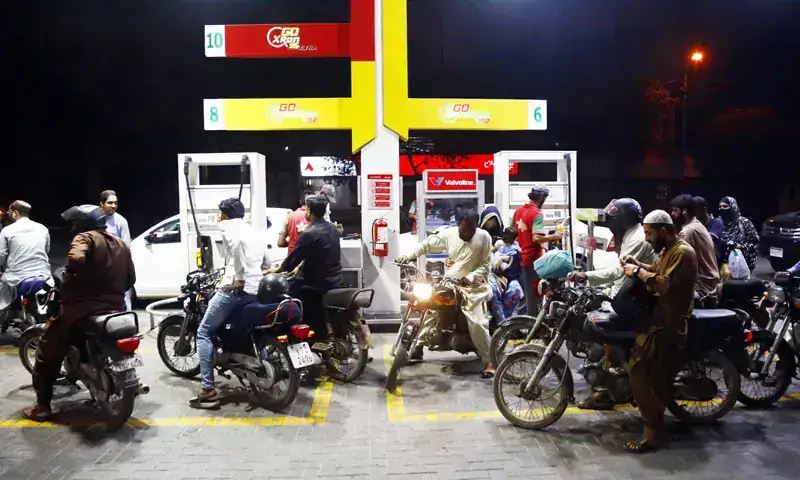
The federal government has increased the prices of petrol and High-Speed Diesel (HSD) once again, taking the former to Rs327.12 per litre and the latter to Rs375.04 per litre.
The price revision comes amidst an announcement by the All Pakistan Petroleum Pump Owners Association (APPPOA) stating that it has deferred a nationwide strike call for two weeks following fresh negotiations with Petroleum Minister Ali Pervaiz Malik.
Under the notification issued by the Petroleum Division, petrol rose by Rs6.39 per litre while HSD increased by Rs7.83 per litre, with the revised rates taking effect on July 23.
The price adjustments follow a breakthrough between the government and fuel station operators.
A day after negotiations over daily petroleum pricing failed, Petroleum Minister Ali Pervaiz Malik held another round of talks with APPPOA representatives, leading to the decision to postpone the nationwide strike.
Addressing the media, Malik assured station owners that the government would address their grievances within two weeks and resolve the issue of dealers’ margins through consultations with all stakeholders, after which a summary will go to the federal cabinet for consideration.
“From February 28 till today, the government has used around Rs100 billion to mitigate the impact of rising fuel prices and initiated a subsidy scheme for the most vulnerable section of the society,” Malik said while detailing measures taken after the Iran-US war broke out.
He noted, “The clouds of war are again building in the region and fuel prices are rising,” adding that APPPOA officials discussed the situation and supported government efforts. Malik also stated that civil and military leadership remains in talks with Iranian and US officials to seek a conflict resolution.
APPPOA Information Secretary Nadeem Aziz Khan confirmed the postponement of the shutdown, stating that the minister has promised that the government would fix fuel prices daily “for two weeks on a trial basis” to evaluate its merits and demerits.
“If it does not cause much difficulty for people, then we will continue it. Otherwise, if there are a lot of difficulties, it will be reconsidered and we will bring it back to our old routine of (fixing prices) every month or on a fortnightly basis again,” Khan cited Malik as saying.
Khan emphasized that the association had not put forward illegitimate demands and was requesting a legitimate right halted since 2022, thanking Malik for taking them on board.
The hold on the strike prevented a major disruption across the fuel distribution network.
Negotiations had collapsed earlier after the decision to revise prices daily led APPPOA to call a nationwide strike starting Wednesday midnight, threatening the closure of approximately 15,000 fuel stations on Thursday.
During the initial discussions, APPPOA Vice Chairman Nauman Ali Butt called daily price revisions “unacceptable to petrol pump dealers and unworkable,” reiterating demands for monthly pricing and higher dealer commissions, which have remained unchanged for three years.
APPPOA Chairman Humayun Khan stated that station owners operate on thin margins and face severe pressure from regulators, oil marketing companies and policy shifts. Khan stated that the daily system “created confusion and destroyed our businesses,” warning that oil marketing companies could manipulate fuel deliveries during price drops, while criticizing the lack of prior consultation.
The price hikes reflect global oil market fluctuations driven by Middle East conflicts.
Prime Minister (PM) Shehbaz Sharif and the federal cabinet authorized the Oil and Gas Regulatory Authority (OGRA) to implement a daily pricing mechanism based on international market trends.
The government had previously moved to weekly revisions in March to manage supply concerns arising from Middle East tensions and the Strait of Hormuz situation.
Fuel prices previously hit peaks of Rs458.41 for petrol and Rs520.35 for HSD on April 3 following the outbreak of the US-Iran war on February 28, when prices started rising from Rs266 and Rs281 respectively.
Monthly sales for petrol and HSD range between 700,000 and 800,000 tonnes, compared to 10,000 tonnes for kerosene.
Petrol price shifts impact lower- and middle-income segments using two-wheelers, rickshaws and small vehicles, while diesel price changes affect the public through heavy transport, generators and power generation costs.





