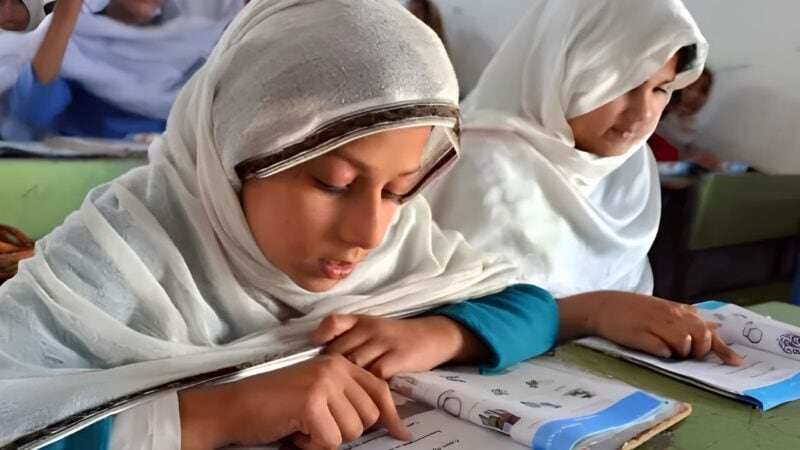
Books based on a new curriculum for Montessori to Grade 5 will be available from the new academic session starting in April 2027, a Punjab government official has told a private media outlet.
According to reports, the revised curriculum aims to reduce the number of textbooks and move students away from rote learning.
Punjab Chief Minister (CM) Maryam Nawaz approved the new curriculum during a meeting in Lahore where officials reviewed the curricula for English, Mathematics, Social Studies, Urdu and Early Childhood Care Education (ECCE).
Punjab Education Curriculum, Training and Assessment Authority (PECTAA) Chief Executive Officer (CEO) Musa Ali Bukhari told a private media outlet that PECTAA prepared the new curriculum and later sent it to Cambridge International Education (CIE) for assessment and comparison with international curricula.
Bukhari said that CIE will provide the final curriculum content in December 2026, after which PECTAA will start printing the textbooks in January.
The new books will become available for the academic session beginning in April 2027, he added.
Bukhari added that the revised curriculum will also help reduce the cost of textbooks by cutting down the number of pages.
He mentioned that the volume of textbooks will decrease by 25 percent and each book will include QR codes that students can use to access video lessons.
The new curriculum will also focus on improving learning outcomes instead of memorisation, he said.
Bukhari added that Cambridge officials involved in developing the curriculum will also train teachers to teach the new syllabus.
According to a statement from the CM’s Office, the meeting also agreed that Saturdays will be dedicated to teachers’ training across Punjab, while authors of the new textbooks will conduct training sessions for teachers.
During the meeting, CM Maryam also directed relevant officials to finalise an artificial intelligence (AI) curriculum for Grades 1 to 12 and stressed the need to develop computer laboratories alongside the new curriculum.
The participants also agreed to introduce mental health training for teachers and considered appointing visiting psychologists in every district.
They also proposed online counselling facilities for students.
The meeting agreed in principle on legislation against corporal punishment in schools, while officials proposed “discipline corners” in classrooms as an alternative to physical punishment.
According to the statement, CM Maryam said that physical violence in schools could have a lifelong impact on children and called for constructive disciplinary measures instead of corporal punishment.
The CM was also informed that English-language training had been completed for 35,000 teachers across 31 tehsils in 12 districts of Punjab.