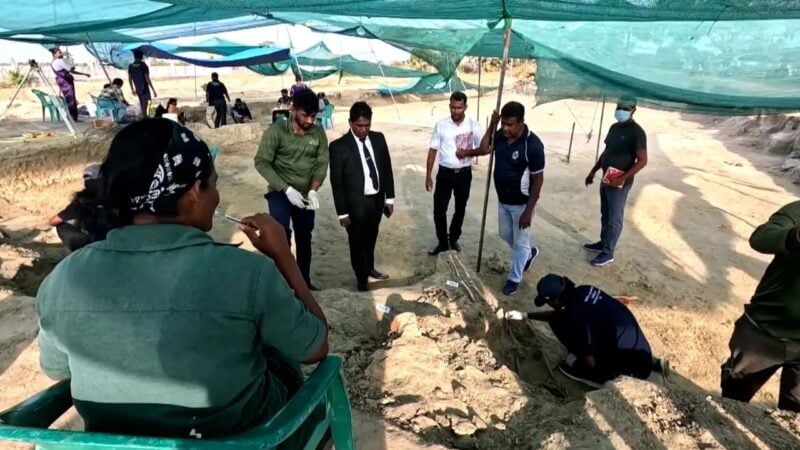
The remains of 582 people, including babies and young children, have been uncovered at a mass grave in Chemmani, near Jaffna in northern Sri Lanka.
The site is linked to allegations that Tamil civilians were killed by Sri Lankan security forces during the country’s civil war, which lasted from 1983 to 2009.
Investigators found adults, children and infants buried in clusters and, in some cases, on top of one another. One skeleton was found headless with both hands bound against its chest.
More than 160 personal belongings were also recovered, including a child’s toy, a milk bottle, footwear, bangles and a blue schoolbag.
Authorities have not yet established whether any of the remains belong to people listed as missing in Sri Lanka. Identification will require forensic examination and could include DNA comparisons with relatives.
The excavation at Chemmani is the largest mass grave investigation in Sri Lanka and follows decades of delays in investigations into suspected killings of Tamil civilians.
The site first came under scrutiny in 1998 during the trial of Sri Lankan soldier Dewage Somaratne Rajapaksa over the rape and murder of an 18-year-old Tamil schoolgirl. Rajapaksa, who remains in prison and is facing a death sentence, told investigators that between 300 and 400 Tamils who had disappeared while in the custody of security forces had been killed and buried at Chemmani.
An excavation in 1999 recovered 15 skeletons. A government investigation later found that 10 of them showed signs of assault and murder, but the inquiry was not continued for decades.
The latest investigation began after construction workers found skeletal remains near a Hindu cremation ground in February 2025.
A court ordered a forensic excavation in May, but the work was halted after funding ran out. It resumed in April this year after the government allocated 21 million Sri Lankan rupees, around £47,000, for the excavation.
Authorities have not yet determined how the victims died.
During Sri Lanka’s civil war, tens of thousands of people, mostly Tamils, were killed and thousands were forcibly disappeared. The Liberation Tigers of Tamil Eelam (LTTE), also known as the Tamil Tigers, fought for an independent state in the north and east of the country after decades of ethnic tensions and discrimination.
Both Sri Lankan security forces and the LTTE have been accused of abductions, killings, rape and other abuses. Jaffna remained under military control from 1995 until the end of the war.
Rights groups and relatives of missing people have called for an international investigation, saying previous inquiries into mass graves in Sri Lanka failed to identify victims or hold those responsible to account.
The Sri Lankan government has maintained that the Chemmani investigation is independent and should proceed through domestic institutions.
Justice Minister Harshana Nanayakkara rejected claims that government agencies had failed Tamil families.
“I’m appealing to everyone. Don’t measure these organisations by their past records, but measure them by the way they work under our government,” he said.
Yogarasa Kanagaranjini, president of the Association for Relatives of the Enforced Disappeared in the north and east of Sri Lanka, rejected the use of domestic investigations.
“We will never accept domestic mechanisms or investigations established by the Sri Lankan government.
“The Sri Lankan state will never deliver justice to us,” he said.