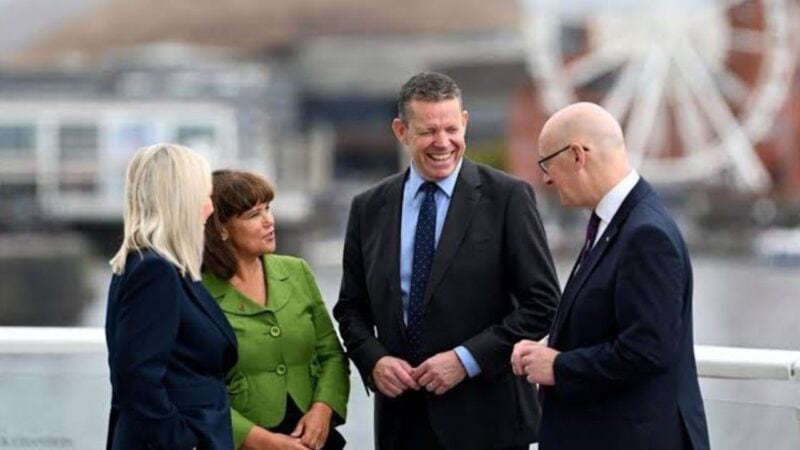
The leaders of Scotland, Wales and Northern Ireland have declared that “Westminster’s time is coming to an end” as their parties push for greater control over their nations’ constitutional futures.
Scotland’s First Minister John Swinney, who leads the Scottish National Party (SNP), Wales’ First Minister Rhun ap Iorwerth, leader of the Plaid Cymru party and Northern Ireland’s First Minister Michelle O’Neill of Sinn Féin signed an agreement on Monday stating that the United Kingdom (UK) government should not have the right to block their nations from deciding their own futures.
The agreement was signed by representatives of the three parties, which support different forms of constitutional change: the SNP backs Scottish independence, Plaid Cymru supports Welsh independence, while Sinn Féin supports the reunification of Northern Ireland with the Republic of Ireland.
“For people watching across these islands – for people watching around the world – there could be no clearer sign that Westminster’s time is coming to an end,” the agreement said.
It added that no Westminster government has the right to block democracy or “undermine the principle that our people will decide their own future.”
Swinney and O’Neill called for referendums on their nations’ constitutional futures, while ap Iorwerth stopped short of setting a timetable for a Welsh independence vote.
Swinney described the meeting as a “pivotal moment in the constitutional journey of the United Kingdom” and said people in Scotland should have the right to decide whether the country becomes independent.
“The people of Scotland, if given the choice of independence in a referendum will take that choice,” he claimed.
Sinn Féin president Mary Lou McDonald, who also attended the meeting, said Northern Ireland had the right to hold a referendum on its future.
“We will not accept or tolerate any prime minister telling us that right is off the table,” she said.
O’Neill, Northern Ireland’s first minister, said that Scotland, Wales and Northern Ireland had different priorities but shared the view that Westminster had failed to serve their people.
In Wales, ap Iorwerth said that there was growing recognition that “Westminster is not working” and argued that more power should be transferred to Wales.
He said the timing of any independence referendum would depend on when the Welsh public was persuaded to support one. Plaid Cymru has ruled out holding such a referendum before the next Senedd election in 2030.
The Welsh government currently does not have the power to hold an independence referendum, with ap Iorwerth calling for that authority to be devolved to Wales.
All three devolved governments are now led by politicians whose parties support their nations leaving the UK or changing their constitutional status.
Later on Monday, the Scottish and Welsh governments signed a separate agreement to work together on funding, devolved powers, child poverty and their relationship with the European Union (EU).
The agreement called for greater fairness in UK funding arrangements and more powers over their constitutional futures.
The UK government rejected the suggestion that Westminster’s role was coming to an end, saying Prime Minister (PM) Andy Burnham remained committed to all four nations of the UK and supported the Union.
The UK is made up of England, Scotland, Wales and Northern Ireland. Scotland, Wales and Northern Ireland have their own devolved governments with powers over certain domestic matters, while Westminster retains authority over areas including the UK’s constitutional arrangements.
Scotland held an independence referendum in 2014, with 55 percent voting to remain part of the UK. Northern Ireland has a separate constitutional process under the Good Friday Agreement that allows for a referendum on Irish reunification if the conditions for one are met.





